 English
 Türkçe


When evaluating the noise of an electric motor, there are two concepts frequently encountered in catalogs and on nameplates: sound power and sound pressure. These two quantities, which are often confused, actually express very different things, and using one in place of the other leads to serious errors. Saying that a motor is "65 dB" carries no meaning unless it is specified whether this value is sound power or sound pressure. In this article we cover the difference between sound power (Lw) and sound pressure (Lp), the effect of distance, which value is given in the catalog, and what can be done to reduce motor noise. For methods of reducing noise and vibration, our article on reducing electric motor noise and vibration is the practical complement to this topic.
What Are Sound Power and Sound Pressure?
Sound power (Lw) is the total acoustic energy a source emits per second; it is a property of the source itself, independent of distance. Sound pressure (Lp), on the other hand, is the magnitude of the pressure fluctuation in the air at a particular point, and it varies with distance, environment and reflections. In short, sound power describes how "strong" the source is, while sound pressure describes how loudly we "hear" it at a particular place.
The Fundamental Difference Between Them
The most important difference is this: sound power is a fixed property of the source, while sound pressure depends on location. The same motor gives a different sound pressure when measured in a quiet room and in an echoing hall; but its sound power is the same in both. For this reason sound power is used to compare motors, and sound pressure is used to evaluate the nuisance at a particular location.
Understanding It Through an Analogy
The difference between sound power and sound pressure is like the difference between the power of a heater (watts) and the temperature at a point (degrees). The heater's wattage is fixed; but the temperature in the room varies according to your distance from the heater and the room's insulation. Likewise, the motor's sound power is fixed, but the sound pressure you hear at a particular point depends on conditions.
What Is the Decibel (dB)?
Both sound power and sound pressure are expressed in decibels (dB), which is an important source of confusion. The decibel is a logarithmic scale: a 6 dB increase in sound pressure corresponds to a doubling of the pressure, while a 3 dB increase in sound power corresponds to a doubling of the power. Because it is logarithmic, dB values are not added directly; when two equal noise sources come together, the total rises by only 3 dB.
dB(A) Weighting
The human ear does not hear every frequency equally; it is especially less sensitive to very low and very high frequencies. For this reason, in noise measurements a filter that mimics the sensitivity of the human ear is applied and the result is given as dB(A). The noise values in motor catalogs are almost always A-weighted, that is, in dB(A); this value better matches the nuisance that people perceive.
The Effect of Distance on Sound Pressure
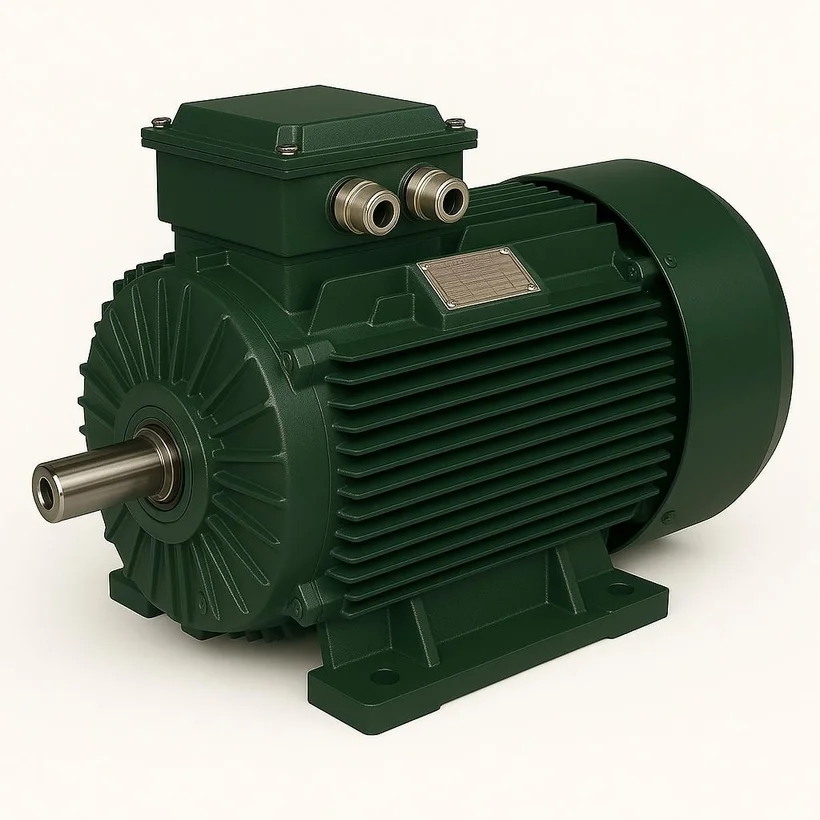
Sound pressure decreases with distance. In the open (under free-field conditions), when the distance from the source doubles, sound pressure drops by about 6 dB. So if you hear 70 dB(A) from a motor at 1 meter, you hear about 64 dB(A) at 2 meters and about 58 dB(A) at 4 meters. For this reason, when a sound pressure value is given, the distance at which it was measured must always be stated.
The Effect of the Environment (Reverberation)
Besides distance, the environment also determines sound pressure. In a hard-walled, echoing space, sound waves reflect off surfaces and the sound pressure rises markedly compared with the open air. The same motor gives a much lower sound pressure in an acoustically softened room. The sound power does not change; what changes is how the environment absorbs or reflects the sound.
Sound Power vs Sound Pressure Comparison Table
The table below summarizes the basic differences between the two quantities. Knowing which value is being used when comparing is the first condition for evaluating motors correctly.
| Property | Sound Power (Lw) | Sound Pressure (Lp) |
|---|---|---|
| Definition | Total acoustic energy emitted | Pressure fluctuation at a point |
| Distance-dependent? | No | Yes |
| Environment-dependent? | No | Yes |
| Purpose of use | Comparing sources | Nuisance at a specific place |
| Directly measured? | Calculated | Measured with a microphone |
Which Value Is Given in the Catalog?
Motor catalogs usually give both the sound power and the sound pressure at a specific distance (most often 1 meter). When comparing two motors, it is more correct to look at the sound power value, because this value is independent of measurement conditions. To predict what the noise will be in a particular location, sound pressure and measurement distance are evaluated together.
Reading the Nameplate Value Correctly
When you hear that a motor is "70 dB," immediately ask this question: is this sound power or sound pressure? At what distance? A-weighted? Without this information, a single dB value is incomplete. When comparing the values of two different suppliers, you must make sure that both give the same quantity (for example, dB(A) sound pressure at 1 meter).
The Sources of Motor Noise
The noise of an induction motor does not come from a single source; it has three main components: ventilation (fan) noise, mechanical (bearing and imbalance) noise, and electromagnetic (magnetic) noise. The share of these three components varies according to the motor's speed, design and operating conditions. To reduce noise, one must first understand which component is dominant.
Fan (Ventilation) Noise
In most standard induction motors the most dominant noise source is the cooling fan. Fan noise rises strongly with speed; for this reason high-speed (two-pole) motors usually run louder than low-speed motors. The fan design, the number of blades and the shape of the fan cover directly affect this noise. Specially designed fans are used in low-noise motors.
Mechanical (Bearing) Noise
The bearings, the quality of the bearing arrangement and the rotor balance determine the mechanical noise. Worn or inadequately lubricated bearings increase noise over time. A well-balanced rotor and quality bearings keep both noise and vibration low. These two phenomena are intertwined; vibration is often a precursor to noise as well.
Electromagnetic (Magnetic) Noise
The magnetic forces between the stator and the rotor create small vibrations in the lamination stack, and this is heard as a hum. Magnetic noise can increase, especially in inverter-driven motors, depending on the switching frequency. A good magnetic design and an appropriate switching frequency choice reduce this component.
The Relationship Between Inverter and Noise
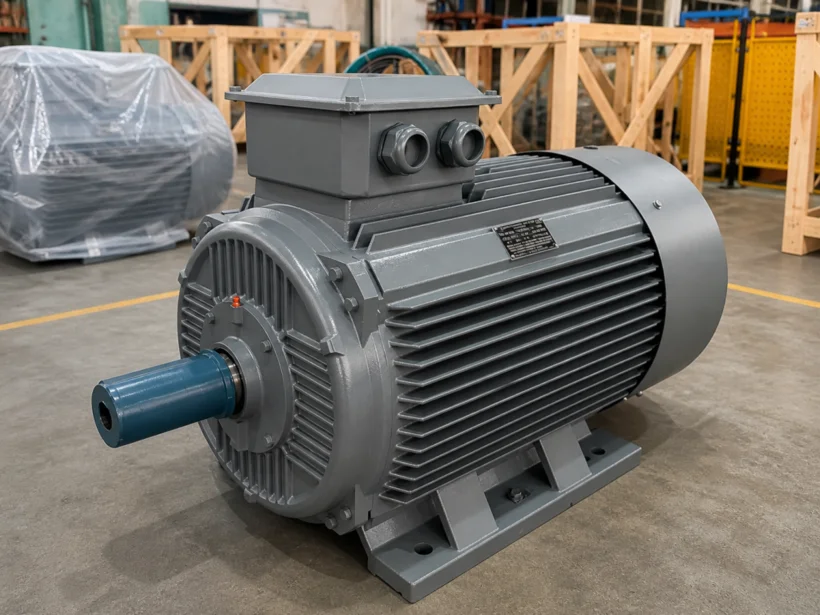
A frequency inverter affects motor noise in two ways. On one hand it reduces fan noise by running the motor at low speed; on the other hand it can add magnetic noise depending on the switching frequency. Moving the switching frequency into a band that the human ear hears less mitigates this hum. For the energy dimension of speed control you can look at our article on energy saving with a frequency inverter.
Speed and Noise
The motor's speed is one of the most decisive factors of the noise level. Low-speed (multi-pole) motors are usually quieter, because fan and aerodynamic noise rises strongly with speed. If it is possible to meet the same application with a lower-speed motor, this often provides a quieter solution. For the relationship of speed, torque and power, our article on pole count and speed is useful.
Motor Selection for Low Noise
In applications where noise matters, motor selection must be done from the very start with a low-noise target. The right speed, quality bearings, a well-balanced rotor and a suitable fan design together provide low noise. In addition, running the motor close to its rated load prevents unnecessary magnetic noise. For correct power selection you can look at our article on high and low kW motors.
Oversizing and Noise
A motor chosen larger than necessary runs at lower efficiency and power factor at partial load and also produces unnecessary fan and magnetic noise. A motor of the right power is both more efficient and often quieter. Our article on the oversized motor and partial load trap covers this topic.
Mounting and Vibration Isolation
How the motor is mounted greatly affects the noise heard. A motor bolted directly to a hard floor transmits its vibration to the structure, and this structure acts like a loudspeaker, increasing the noise. Vibration mounts and flexible connections cut this transmission, reducing both noise and structural fatigue. We detailed these methods in our article on reducing noise and vibration.
Noise in Pump and Fan Applications
In pump and fan systems, noise often comes not from the motor but from the fluid itself (hydraulic or aerodynamic). In these systems, lowering the speed both saves energy and markedly reduces noise. For motor selection suited to the application, you can look at our articles on the water pump motor and the fan and blower motor.
Noise in Compressor Applications
Compressors are challenging applications in terms of noise due to both their high starting torque and their fluctuating load. Here the motor noise combines with the compressor's own mechanical noise. Correct motor selection and suitable isolation keep the total noise at an acceptable level. Our article on starting torque in compressor motors covers this application.
The Relationship Between Efficiency and Noise
High-efficiency motors usually run with fewer losses, hence less heat and often lower noise. The reduction in losses contributes to a reduction in fan and magnetic noise too. To understand motor losses, our articles on electric motor efficiency losses and high-efficiency electric motors are good resources.
Its Relevance to Power Factor
Although noise does not directly change power factor, harmonic-related magnetic hum can indicate both noise and power quality problems. A well-designed motor offers both low noise and high power factor. Our article on power factor (cosφ) explains this topic.
Noise Management in an Industrial Environment
When many motors run together in an industrial facility, the total noise is the logarithmic sum of the noise of the individual motors. For this reason, keeping the sound power of each motor low is critical for a quiet environment across the facility. Correct motor selection, correct placement and suitable isolation together improve the working environment. Our article on industrial electric motors offers this holistic view.
What to Watch For in Noise Measurement
For a reliable noise evaluation, the measurement conditions must be standard. The measurement distance, the acoustics of the environment, the background noise and the motor's load condition affect the result. For this reason, when comparing two motors, you must use values of the same quantity (sound power or sound pressure at a specific distance) measured according to the same standard. Otherwise apples are compared with oranges.
The Logic of Adding dB Values
A practical consequence of the logarithmic scale is that the dB values of noise sources cannot be added arithmetically. When two equal noise sources (for example two 70 dB motors) come together, the total is not 140 dB but about 73 dB; that is, it rises by only 3 dB. With two sources that differ greatly, the smaller one contributes almost nothing; the sum of a 70 dB and a 60 dB source is in practice still very close to 70 dB. Knowing this logic makes it easier to understand which motor in a facility will really make a difference when quieted: focusing on the source with the highest sound power is the most effective way to lower the total noise.
The Effect of Load Condition on Noise
A motor's noise also varies with the operating load. A motor spinning at no load produces only fan and mechanical noise, while under load the magnetic noise component rises. In addition, an overloaded or strained motor can produce both more heat and more vibration and noise. For this reason, when catalog values are given, the load condition under which the motor was measured also matters. A motor running close to its rated load, in balance, is usually at the most efficient point and the most predictable one in terms of noise.
Hearing Health in the Working Environment
Noise is not only a matter of comfort but also an occupational health issue. Prolonged exposure to high sound pressure can cause hearing loss. For this reason, in industrial environments where many motors run, the sound pressure level to which workers are exposed must be kept below certain limits. What is decisive here is not so much the sound power of the source but the sound pressure at the point where the worker stands. Quieting the motor, insulating the environment or moving the worker away from the source are complementary approaches that reduce this exposure. Choosing motors with low sound power is the most lasting way to shrink the problem from the very start of this chain.
The Importance of Frequency Components
A single dB(A) value gives the total intensity of the noise but hides the frequency distribution. Of two motors at the same dB(A) level, one may emit an annoying high-pitched hum and the other a more muffled sound. In some applications, especially with motors installed near living spaces, the frequencies at which the noise concentrates are also evaluated. A high-pitched magnetic hum is usually related to switching or magnetic design, while a low-frequency hum often points to mechanical imbalance. Frequency analysis is a powerful way to diagnose the noise source.
DRG Motor for a Correct and Quiet Motor
Understanding the difference between sound power and sound pressure is the first step toward comparing the noise of motors correctly and choosing the quietest solution for the application. Low noise is achieved through the combination of the right speed, a well-balanced rotor, quality bearings, a suitable fan design and a robust magnetic design. DRG Motor supplies induction motors in the IE3, IE4 and IE5 efficiency classes, designed with a low-noise and low-vibration target. To choose the quiet and efficient motor most suitable for your application, you can contact the DRG Motor team and review our motor portfolio on our DRG electric motor product page. To reinforce the fundamentals, you can also look at our article on what an electric motor is.