 English
 Türkçe

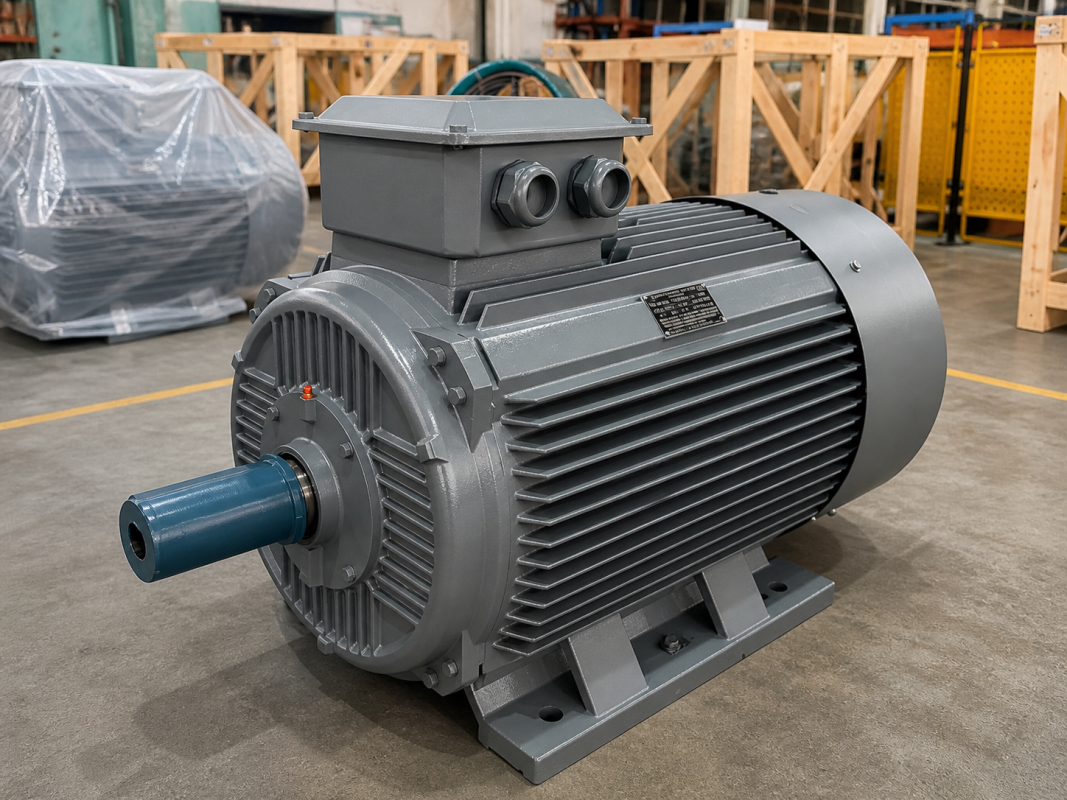

Choosing the right electric motor is not enough on its own; the cable that feeds that motor must also be chosen correctly. A wrongly chosen supply cable becomes the weak link of the system even if the motor is perfect. A cable of inadequate cross-section overheats, creates voltage drop and even poses a fire risk. A cable thicker than necessary, on the other hand, increases the investment cost in vain. In this article we examine in detail how to size the supply cable for a motor, how the full-load current is calculated, the effect of voltage drop and installation conditions on the cross-section, the role of the starting current, and the basic principles of cabling suited to DRG's IE3/IE4/IE5 class asynchronous motors.
Why is the cable cross-section so important?
The cable cross-section determines the amount of current the cable can safely carry. As current passes through a cable, it produces heat because of the resistance of the conductor. As the cross-section gets smaller, the resistance increases, so more heat is produced at the same current. For this reason the cross-section must be chosen to suit the current the motor will draw. An inadequate cross-section creates problems for both safety and performance.
What is full-load current?
The full-load current (FLC) is the current the motor draws from the network while running at its rated power. This is the basic input for cable cross-section selection. In a three-phase motor the full-load current depends on the power, voltage, power factor and efficiency of the motor. A motor of higher power naturally draws more current and requires a thicker cable.
How is the current calculated?
The full-load current of a three-phase motor is found by dividing the power by the product of the voltage, the square root of three, the power factor and the efficiency. In practice this calculation is done using the motor's nameplate values. The current value written on the nameplate can often be used directly without the need for calculation; because the supplier already declares this value.
Power-current-cross-section table for a 400V system
The table below summarises the approximate full-load current and recommended copper cable cross-section for typical motor powers in a 400V three-phase system. The values are typical; the actual selection must be corrected according to the installation and temperature conditions.
| Motor power (kW) | Full-load current (A) | Recommended copper cross-section (mm²) |
|---|---|---|
| 0.75 | ~1.8 | 1.5 |
| 1.5 | ~3.4 | 1.5 |
| 2.2 | ~4.9 | 1.5 |
| 4 | ~8.5 | 2.5 |
| 5.5 | ~11.5 | 2.5 |
| 7.5 | ~15.5 | 2.5 |
| 11 | ~22 | 4 |
| 15 | ~29 | 6 |
| 18.5 | ~35 | 10 |
| 22 | ~42 | 10 |
| 30 | ~56 | 16 |
| 37 | ~68 | 25 |
| 45 | ~82 | 35 |
| 55 | ~100 | 50 |
| 75 | ~135 | 70 |
| 90 | ~160 | 95 |
Why is the table only a starting point?
The table above is a reference for ideal conditions. In a real plant, factors such as cable length, installation method, ambient temperature and the number of cables laid together can require increasing the cross-section. For this reason the table values should be used as a starting point and then corrected according to the conditions.
What is voltage drop?
As current passes through a cable, a voltage difference forms between its two ends because of the cable's resistance. This difference is called voltage drop. The longer and thinner the cable, the more the voltage drop increases. When the voltage reaching the motor drops, the motor's torque and performance decrease; in extreme cases the motor cannot even start.
Why must voltage drop be limited?
The generally accepted practice is that the voltage drop up to the motor should not exceed a certain percentage (typically 3-5%). A voltage drop exceeding this limit reduces the motor's efficiency, increases its heating and shortens its life. In long-distance feeds, the cross-section is often determined by the voltage drop criterion rather than by heating.
The effect of cable length
As the cable gets longer, the total resistance increases; this increases both heating and voltage drop. While the table value is sufficient for a short feed, it may be necessary to step up to a larger cross-section when the same motor is far away. For this reason, how far the motor is from the panel is an inseparable part of cross-section selection.
The effect of ambient temperature
The current a cable can carry depends on the ambient temperature. In a hot environment the cable can cool less, so its carrying capacity drops. In this case a thicker cable is needed for the same current. The temperature correction factor must always be taken into account in cross-section selection.
The effect of the installation method
How the cable is installed also affects its carrying capacity. A cable installed in free air cools better than one installed in a conduit or buried in the ground. Many cables laid side by side heat one another and reduce their capacities. These installation factors can require increasing the cross-section.
The role of starting current
A motor draws a current far above its rated current at its first start; this is called the inrush current. This high current is short-lived, but the cable and protection elements must take it into account. The cable cross-section is usually determined according to the continuous full-load current; the starting current mainly affects the setting of the protection elements.
Coordination with the protection element
The cable cross-section must be coordinated with the fuse or breaker that protects it. The protection element must not pass more current than the cable can carry; otherwise the cable overheats and cannot do its protective duty. In panel and contactor selection, the cable cross-section and the protection element must be evaluated together.
The relationship with overload protection
The cable must also be coordinated with the motor's overload protection. The overload relay protects the motor; but the cable must safely carry the current until this protection acts. When the cable, protection and motor trio are chosen in harmony with one another, the system runs safely and in balance.
Copper or aluminium?
The cable conductor is usually copper or aluminium. Copper is a better conductor; a thinner cross-section is sufficient for the same current. Aluminium is cheaper and lighter but requires a thicker cross-section for the same current. In most motor feeds, especially at medium powers, copper cable is preferred.
Feeding through a variable frequency drive
If the motor is fed through a variable frequency drive, the cabling requires special attention. The high-frequency voltage at the drive output creates additional losses and electromagnetic interference in the cable. For this reason, shielded cable is usually used in drive feeds and the cross-section selection is made accordingly.
The grounding conductor
The supply cable does not consist only of phase conductors; it also contains a protective grounding conductor. This conductor provides the motor's grounding and safely conducts the leakage current to earth in case of a fault. The cross-section of the grounding conductor must be chosen in proportion to the phase cross-section.
Cabling in conveyor applications
In long belt conveyors the motors are often quite far from the panel. In this case voltage drop becomes critical and the cross-section must be increased according to the distance. In conveyor belt motor selection, the cable cross-section depends as much on the distance as on the power of the motor.
Cabling in crane applications
In crane and lifting systems the motors may be mobile; this requires flexible and durable cable. In crane and lifting motors, the mechanical strength of the continuously moving cable is as important as the cross-section. Special flexible cables are preferred in mobile applications.
Reserve capacity and future planning
When selecting the cable cross-section, not only today's need but also a possible future capacity increase must be considered. Leaving some reserve cross-section makes it unnecessary to replace the cable if a larger motor is installed later. Since laying cable is an expensive job, being a little generous from the start is often economical.
Cable connection quality
Even a cable of the correct cross-section creates problems if its connection is poor. A loose or poorly tightened connection creates resistance and heating at that point. This local heating over time degrades the connection and can even cause a fire. For this reason, connecting the cable ends with the correct lugs and the correct torque is as important as cross-section selection.
Insulation class and the cable
The insulation of the cable must be suited to the temperature and environment in which it will operate. The insulation of a cable running at high temperature must withstand this; otherwise the insulation ages and a short circuit risk arises. Like the motor's insulation class, the cable's insulation type must also be chosen in harmony with the environment.
Cabling in industrial plants
In heavy industry, cables run in demanding environments, over long distances and at high currents. In industrial electric motor applications, cable selection is an engineering decision that directly affects the reliability of the system. The correct cross-section both reduces energy loss and increases safety.
The basic logic of cable cross-section selection
Ultimately, cable cross-section selection is about delivering the current an electric motor needs to the motor safely and without loss. This is a holistic decision in which the current calculation, voltage drop, installation conditions and protection coordination are evaluated together. No single factor is sufficient on its own; the correct cross-section is found by providing all of them together.
Common mistakes
The most common mistake in cable selection is looking only at the motor power and applying the table value directly. Ignoring the cable length, ambient temperature and installation conditions leads to an inadequate cross-section. Another common mistake is not taking into account the starting current and protection coordination. Avoiding these mistakes ensures the long life of the system.
The effect of power factor on current
The current a motor draws depends not only on its power but also on its power factor (cos φ). A motor with a low power factor draws more current from the network for the same useful power. This extra current increases the heating of the cable and may require a thicker cross-section. In high-efficiency motors the power factor is usually better; this provides an advantage in terms of both the cable and the feed.
The reflection of efficiency on cable selection
The motor's efficiency also affects the current it draws. A more efficient motor produces the same mechanical power with less electrical power; therefore it draws less current. This is an indirect advantage of high efficiency classes such as IE3, IE4 and IE5: lower current often means a smaller cable cross-section and less energy loss. Efficiency affects not only the electricity bill but also the cabling cost.
The effect of harmonics
In motors fed by a drive the current is not a perfect sine wave; it contains harmonics. These harmonics increase the effective current of the cable, creating additional heating. For this reason, in drive feeds the cable cross-section should be chosen a little more generously, taking into account the effect of harmonics and not only the fundamental current. Ignoring the harmonic load causes the cable to run hotter than expected.
Use of parallel cables
In very high-power motors, instead of a single thick cable, several thinner cables can be connected in parallel. Parallel cables both ease the installation and improve heat dissipation. However, in parallel cables each conductor must be laid at the same length and under the same conditions; otherwise the current does not distribute equally and one cable is loaded more than the other. Parallel cabling requires a careful design.
Cable route and mechanical protection
The route the cable follows determines the risk of mechanical damage. Cables laid in passageways, near moving equipment or at sharp corners require mechanical protection. A damaged cable, no matter how correctly its cross-section was chosen, creates a short circuit and safety risk. For this reason, route planning is a design step as important as the cross-section calculation.
Resistance to environmental conditions
The outer sheath of the cable must be resistant to the environment in which it will operate. In oily, chemical, humid or UV-exposed environments a standard cable sheath can degrade rapidly. Choosing a sheath suited to the environment ensures the long life of the cable. As much as the cross-section, the cable type and sheath material must also be determined according to the environment analysis.
Short-circuit withstand
The cable cross-section must withstand not only the normal operating current but also a possible short-circuit current. At the moment of a short circuit a very high current flows for a very short time; the cable must not overheat during this time. The protection element cutting the short circuit quickly enough and the cable cross-section withstanding this short-lived current are designed together. This is a criterion that must not be overlooked, especially in high-power feeds.
Neutral and phase balance
In a three-phase balanced motor load, since the current between the phases is balanced, the neutral conductor carries very little current. However, in unbalanced loads or systems containing harmonics, the neutral conductor can carry more current than expected. In this case the neutral cross-section must also be chosen carefully. Since balance is usually achieved in motor feeds, this issue rarely causes a problem, but it should not be overlooked.
Cable check at commissioning
When a system is commissioned, the cable's connections, insulation resistance and temperature must be checked. At the first start it should be observed whether the cable overheats, and the connection points should be checked again after a certain time. These simple checks prevent failures and safety problems that could occur later.
Cable lug selection
The cable is usually connected to the motor and panel terminals with lugs. The lug must be chosen to suit the cable cross-section and the terminal type. A lug of the wrong size or poorly crimped increases the connection resistance and leads to heating. The correct lug and correct crimping ensure that the capacity provided by the cable cross-section is preserved at the connection point as well.
The balance between cost and safety
Cable selection is always a cost-safety balance. The thinnest acceptable cross-section is the cheapest, but it reduces future flexibility and the safety margin. A slightly thicker cross-section, although it seems costly at the start, provides lower loss, less heating and a longer life. This balance must be set according to the priorities of the plant.
DRG's approach to correct cabling
As DRG Motor, the full-load current is clearly declared on the nameplates of the IE3, IE4 and IE5 class asynchronous motors we supply; this is the first step of correct cable cross-section selection. Determining the cable cross-section suited to your motor's power, distance and operating environment, together with the protection elements, is critical for both safety and efficiency. To evaluate together the most suitable motor for your application and the cabling approach to match it, you can contact the DRG Motor expert team.