 English
 Türkçe

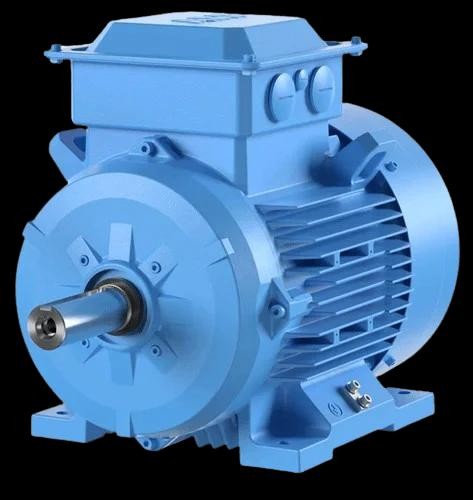

Every mechanical structure has a frequency at which it vibrates most easily when slightly disturbed; this is called the natural frequency. The sound you hear when you tap a glass with your finger, or the sway of a bridge in the wind, are all the work of natural frequency. An electric motor and the machine it drives are also mechanical structures and have their own natural frequencies. The condition that arises when the motor's rotational speed coincides with one of the system's natural frequencies is called mechanical resonance, and the speed at which this coincidence occurs is called the critical speed. At resonance, vibration amplitudes can reach dangerous levels; bearings are strained, noise rises, bolts loosen, and structural damage can occur over time. A system that looks problem-free in ordinary operation can suddenly start vibrating violently only when it reaches a certain speed; this is the most insidious side of resonance. In this article we examine, from the DRG Motor engineering perspective, what natural frequency is, why critical speed is dangerous, how the resonance region is avoided with variable-speed drives, how the skip frequency is used, the role of foundation and frame stiffness, and the relationship with balancing. Our goal is to provide concrete information so you can both diagnose resonance and prevent it as early as the design stage.
What is natural frequency?
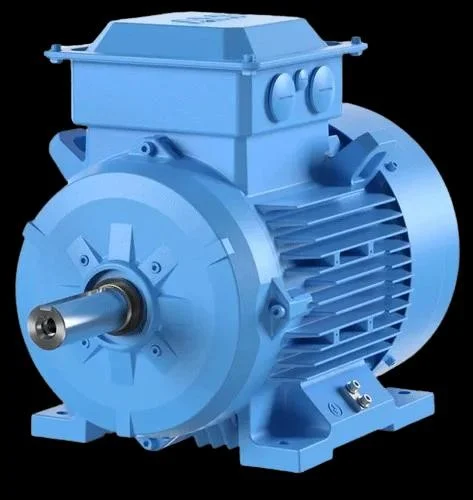
Natural frequency is the frequency at which a structure vibrates on its own when released. Just as a tuning fork rings at a particular note, every motor-machine assembly vibrates most easily at certain frequencies. This frequency depends on the structure's mass and stiffness: stiffer and lighter structures have a higher natural frequency, while more flexible and heavier structures have a lower natural frequency.
How does resonance occur?
When a repeating force is applied to a structure at a frequency close to its natural frequency, each push adds to the previous one and the vibration amplitude grows rapidly. This event is called resonance. In an electric motor, the main source of the repeating force is the rotor's rotational frequency. When the rotational frequency approaches the system's natural frequency, even a small imbalance turns into large vibration.
What is critical speed?
Critical speed is the rotational speed at which the motor's rotational frequency coincides with the system's natural frequency. At this speed the system enters resonance and vibration reaches its highest value. A fixed-speed motor must be selected so that its operating speed is sufficiently far from the critical speed. In variable-speed applications, however, the critical speed may fall within the operating range and requires special measures.
Why does vibration grow at resonance?
At resonance, the energy of the applied force accumulates in the system because a push comes in the same direction each cycle. The structure's damping capacity is the only thing limiting this accumulation. If damping is low, the vibration amplitude can rise far above safe limits. For this reason, resonance is a special condition in which even a small imbalance can cause major damage.
The harms of resonance
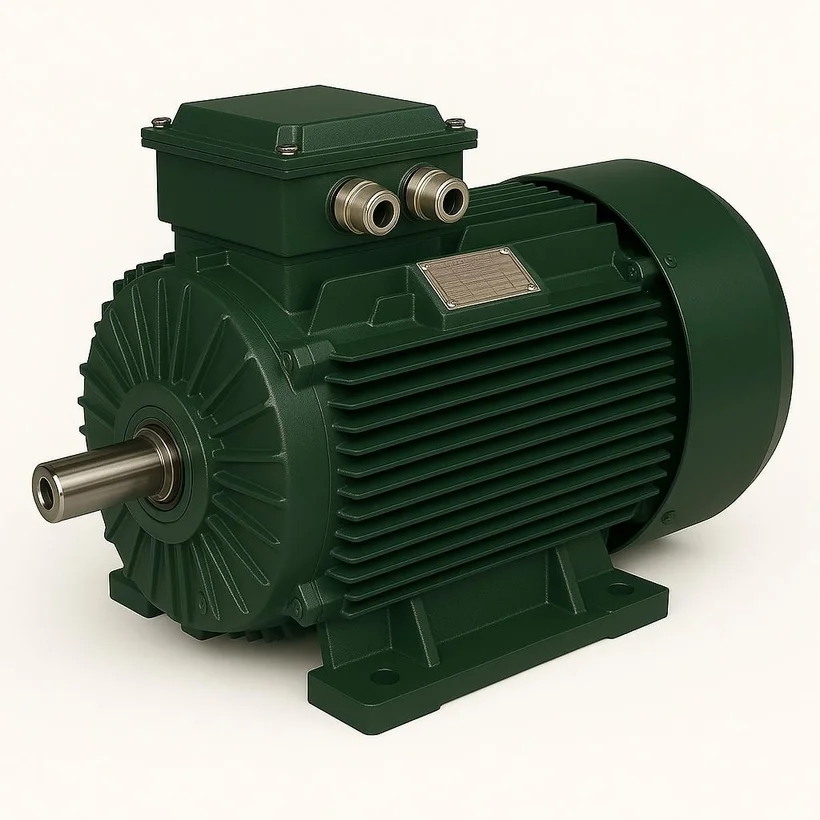
In a motor running in resonance, the bearings are exposed to excessive dynamic load and their life shortens rapidly. Bolts loosen, weld seams can crack, and the shaft can be subjected to fatigue cracks. High vibration also produces unacceptable noise and affects other surrounding equipment. A system running in resonance for a long time fails seriously in a short time; sometimes even running in resonance for a single night can cause permanent damage. Moreover, this damage is cumulative: each resonance cycle adds a small amount of fatigue to the material, and this fatigue can turn into a sudden fracture over time. For this reason, resonance is an operating condition that must absolutely be avoided.
Critical speed and vibration table
The table below summarizes vibration behavior and the recommended approach according to the position of the operating speed relative to the critical speed. The values are conceptual; the natural frequency of each system must be determined by measurement.
| Operating speed / critical speed | Vibration behavior | Recommended approach |
|---|---|---|
| Far from critical speed | Low, safe | No problem |
| Approaching critical speed | Noticeable increase | Monitor carefully |
| At critical speed | Very high (resonance) | Do not run at this speed |
| Past critical speed | Drops again | Pass through quickly |
As the table shows, the aim is to keep the operating speed away from the critical speed; if it cannot be avoided, to pass through that region quickly.
Variable speed and the resonance region
The speed of a motor fed by a frequency inverter can be varied over a wide range. This flexibility is an advantage, but it also brings a risk: a critical speed may exist within the operating range. When the motor reaches that speed, it enters resonance. For this reason, in variable-speed systems the critical speeds must be determined in advance and the drive configured so that it does not run permanently at these speeds.
Skip frequency
Modern frequency inverters have a skip frequency feature for certain speed bands. The frequency band corresponding to the critical speed is defined in the drive; the drive does not run permanently at a speed in this band but passes through that region quickly. Thus the motor does not run in the resonance region for a long time and is protected from high vibration. When defining the skip band, a band of a certain width around the critical speed should be chosen, not exactly on top of it, because resonance is effective not only at a single point but also in a narrow region around it. When the drive enters this band, it holds at the nearest safe frequency either below or above it. This feature is the most practical and most widely used way of dealing with resonance in variable-speed applications; it often solves the problem without requiring a mechanical change.
Fast passage through the resonance region
It is not always possible to completely avoid the critical speed; some systems must pass through the critical speed during start-up. In this case, what matters is not to dwell in that region and to pass through quickly. The drive's acceleration ramp should be set fast enough not to give the vibration a chance to grow in the resonance band. Resonance needs time to grow; the faster the system passes through that region, the less the vibration develops. A short passage is far less harmful than permanent operation. The same logic applies during stopping: the motor also passes through the same critical speed while decelerating, so the deceleration ramp should also be kept fast.
Foundation and frame stiffness
The system's natural frequency depends largely on the stiffness of the foundation and frame. A weak, flexible frame creates a low natural frequency, and this frequency may fall within the operating range. A rigid, solid foundation, on the other hand, raises the natural frequency and moves it away from the operating speed. For this reason, in motor installation the solidity of the foundation is the cornerstone of vibration control. Most resonance problems actually arise from an inadequate mounting base; even if the motor and machine are flawless, if the structure they sit on is flexible the system is prone to resonance. For this reason, the surface the motor sits on must be flat, solid, and rigid enough to transfer vibration to the base structure.
The role of foundation mass
A heavy, rigid foundation both determines the natural frequency and absorbs vibration energy. A motor running on a foundation of insufficient mass can amplify its own vibration. The general engineering approach is for the mass of the concrete base to be several times the mass of the machine sitting on it; this way the foundation steadily resists the dynamic forces the machine produces. A concrete base or a sufficiently thick steel frame is used to move the system's natural frequency outside the operating region. Foundation design allows the resonance problem to be solved as early as the installation stage and prevents costly interventions that would arise later.
Relationship with balancing
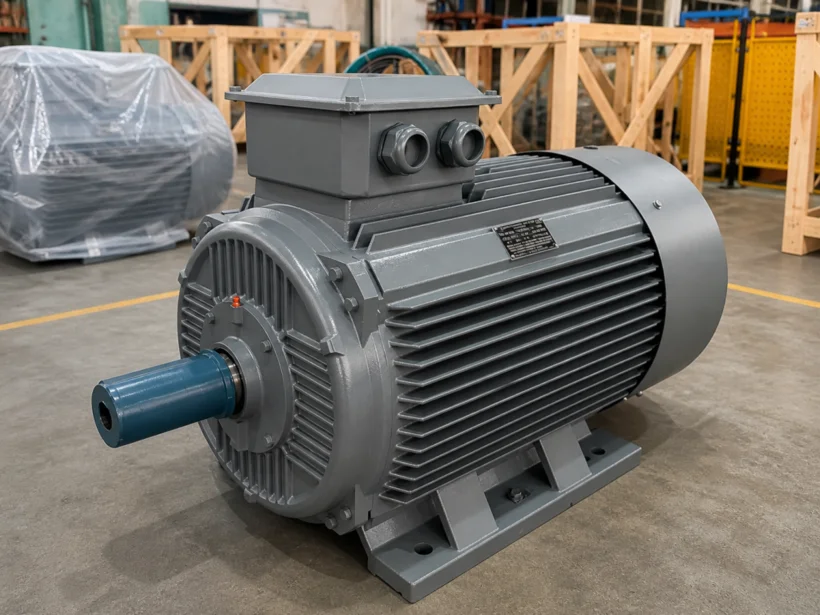
The main source of the repeating force that triggers resonance is rotor imbalance. A well-balanced rotor produces a very small exciting force; even if resonance is approached, vibration stays limited. A poorly balanced rotor, on the other hand, creates very large vibration when the critical speed is approached. For this reason, balancing is one of the most effective ways to reduce the effect of resonance.
Imbalance and exciting force
The force caused by imbalance increases with the square of the rotational speed. This means that even a small imbalance turns into very large forces at high speeds. For example, when the speed doubles, the same imbalance produces a force four times larger. When the critical speed is approached, this force combines with resonance and vibration multiplies. For this reason, precise balancing is essential in high-speed applications. Proper balancing of the rotor minimizes vibration both in normal operation and near resonance; a well-balanced rotor keeps vibration within manageable limits even in systems that inevitably pass through the critical speed.
Finding the critical speed with vibration measurement
A system's critical speed can be determined by vibration measurement. While the motor is slowly accelerated, vibration is monitored; the speed at which the amplitude peaks is the critical speed. This method is called a slow run-up test and reveals the resonance points across the system's entire operating range. Some systems may have more than one critical speed; each must be determined. This measurement concretely shows where the system enters resonance and ensures the skip frequency is set correctly. Vibration measurement is the most reliable way to diagnose a resonance problem; because it relies on numerical data rather than guesswork, it also forms the basis of the correct solution.
Frequency spectrum analysis
Decomposing the vibration signal into its frequency components reveals the fingerprint of resonance. A distinct peak at the rotational frequency in the spectrum, and the growth of this peak when the critical speed is approached, is a sign of resonance. We addressed this analysis in detail in our article on motor vibration analysis and FFT spectrum; this method is indispensable in resonance diagnosis.
Resonance or imbalance?
It is important to distinguish the source of high vibration. While imbalance produces a certain proportion of vibration at every speed, resonance shows a sharp increase only in a certain speed band. Observing how vibration changes by varying the speed helps to distinguish whether the problem is resonance or imbalance. Correct diagnosis is a precondition for the correct solution.
Relationship with noise
Resonance produces a distinct noise along with high vibration. The ringing of the structure and the sudden rise of the sound at a certain speed are the audible signs of resonance. An experienced operator can notice that resonance has been entered by hearing this sudden change in the motor's sound. Noise and vibration often come from the same root; the two must be evaluated together. We examined general noise and vibration reduction methods in our article on reducing electric motor noise and vibration.
Torque, speed, and vibration
The torque the motor produces and the speed at which it turns directly affect vibration behavior. As speed changes, the system's distance from the critical speed also changes. Understanding the relationship between power, torque, and speed helps to interpret resonance correctly. We addressed this fundamental relationship in our article on the motor power, torque, and speed relationship.
Solution options
There are several ways to deal with a resonance problem: changing the operating speed, shifting the system's natural frequency by adding stiffness or mass, defining a skip frequency, or balancing the rotor better. Which of these options is applied depends on the system's structure and operating requirement. In a fixed-speed application, increasing foundation stiffness or improving balancing is usually sufficient; in a variable-speed application, the skip frequency is the most practical solution. These methods are often applied together. The correct solution is determined by a correct analysis of the system's natural frequency and operating conditions; a single method does not suit every problem, so diagnosis comes before the solution.
Resonance in industrial applications
Resonance is a real risk in fans, pumps, compressors, and all variable-speed drive systems. Especially in applications where speed is varied with an inverter, determining the critical speeds is essential. Our article on industrial electric motors covers the requirements of these applications broadly.
Connection and mounting looseness
Sometimes the problem is not in the system's natural frequency but in looseness in the mounting. A loose foot bolt, an untightened base, or a connection with play can lower the structure's stiffness and shift its natural frequency into the operating region. For this reason, the first thing to do when resonance is suspected is to check the tightness of all mounting connections. Even a simple tightening operation, in some cases, noticeably reduces vibration and solves the problem at its root.
Isolation and damping elements
In some applications, vibration isolation pads or damping elements are used. These are placed between the motor and the foundation to reduce the transfer of vibration to the structure. However, a wrongly selected isolation element can lower the system's natural frequency and move resonance into the operating region. For this reason, damping elements must be selected with the system's natural frequency in mind; a random pad often deepens the problem rather than solving it.
Natural frequency changing with wear
A system's natural frequency can change over time. Increasing bearing clearances, loosening connections, or cracks forming in the foundation can gradually drag a system that was initially safe into the resonance region. For this reason, vibration must be monitored regularly not only at commissioning but throughout the system's entire life. A slowly increasing vibration can be an early sign that the natural frequency is shifting.
Prevention at the design stage
Resonance is best prevented at the design stage. The foundation and frame should be designed and the motor selected correctly so that the system's natural frequency is kept outside the operating speed range. Solving resonance problems that arise in the field is always harder and more costly than designing correctly from the start.
DRG Motor for vibration-free operation
Mechanical resonance is a phenomenon that can be easily brought under control when correctly understood, but that rapidly wears out the system when ignored. A correctly balanced rotor, a rigid foundation, a correctly selected operating speed, and a skip frequency when needed ensure your motor runs free of resonance, quietly, and with a long life. DRG Motor produces low-vibration AC induction motors with precisely balanced rotors and a solid mechanical structure; you can contact the DRG Motor engineering team for the right motor selection and vibration control for your application. A vibration-free system begins with the right motor and the right installation.