 English
 Türkçe

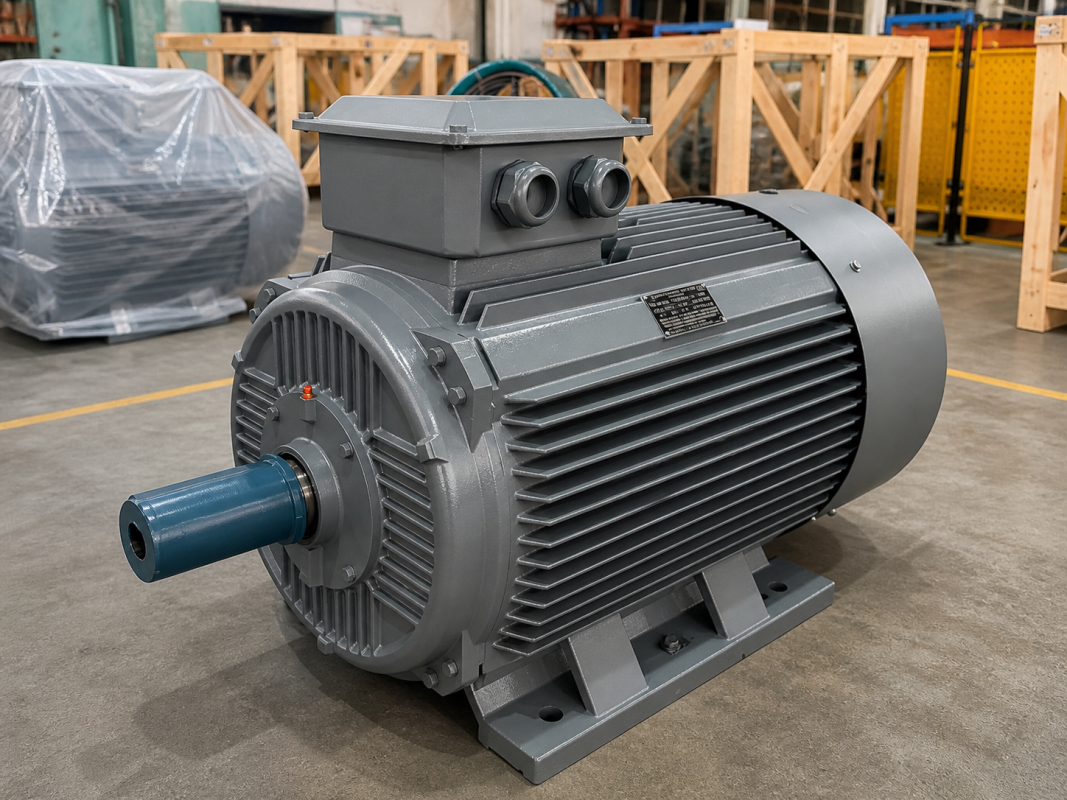

A frequency inverter provides large energy savings by flexibly adjusting the motor's speed; but this benefit comes with an invisible side effect: electrical noise. The inverter drives the motor by converting the fixed grid voltage into pulses that switch on and off very rapidly. This fast switching produces high-frequency interference that both spreads along the cables and radiates into the air. This interference can affect sensitive devices in the same facility, disrupt measurement systems and even shorten the motor's own life. This is exactly where EMC, that is electromagnetic compatibility, and filters come into play. In this article we address, from DRG's engineering perspective, the source of the electrical noise produced by the inverter, common-mode currents, input and output filters, the importance of shielded cable and grounding, and how to build a healthy inverter-fed motor system.
What Is EMC and Why Does It Matter?
Electromagnetic compatibility (EMC) means that a device neither emits electrical noise above an acceptable level into its surroundings nor is affected by the noise of other devices. In a facility, dozens of devices share the same environment; if one produces excessive interference, the others may fail. Since inverters are powerful noise sources, EMC compliance carries special importance in inverter-fed systems.
Why Does an Inverter Produce Noise?
Modern inverters use pulse width modulation (PWM) to drive the motor. In this method, the voltage switches on and off very rapidly thousands of times per second. At each switching instant, the voltage changes with an extremely steep edge; these steep edges produce electrical noise across a wide frequency band. The faster the switching, the more efficiently the motor is driven, but the more the noise rises too. This is an unavoidable balancing matter.
The basic physics here is this: the shorter the time in which a voltage changes, the wider the frequency range over which it emits energy. Because the pulses produced by the inverter rise in the order of microseconds, the resulting noise covers a wide band stretching from kilohertz to megahertz. That is why it is impossible to eliminate inverter noise completely with a single filter; different frequency regions must be addressed with different measures. This layered approach lies at the foundation of EMC design.
Conducted and Radiated Noise
Inverter noise spreads in two ways. The first is conducted noise; the interference travels back to the grid over the power cables and reaches other devices connected to the same line. The second is radiated noise; the interference is scattered into the air from the cables and the device like an antenna and affects nearby signal cables. An effective EMC solution aims to close both of these paths.
Common-Mode Current: The Hidden Danger
The most insidious problem in inverter-fed systems is common-mode current. The PWM waveform causes the sum of the three phases not to be zero; this creates a high-frequency current circulating through the motor housing, the grounding line and the cable capacitances. Common-mode current both emits interference and can damage the motor bearings. We addressed the shaft voltage and bearing damage caused by this current in our article on long motor cable, dv/dt and reflected wave.
The insidious nature of common-mode current is that it often does not show up in normal measurements. The phase currents look balanced, the motor seems to run smoothly; but in the background, a high-frequency current circulating through the grounding lines both emits interference and accumulates voltage on the shaft. The way to bring this hidden current under control is to deliberately offer it a low-resistance, short and controlled return path. Shielded cable and correct grounding do exactly this job; instead of releasing the current, they direct it into a safe channel.
Input Filter (EMC Filter)
The EMC input filter placed on the grid side of the inverter prevents conducted noise from returning to the grid. This filter is a circuit made of inductors and capacitors; it filters out high-frequency interference and prevents the unclean current from reaching other devices on the line. Many inverters have a basic EMC filter built in; in tougher environments, an external filter is added.
Problems on the Output Side
Noise causes problems not only on the grid side but also on the output cable between the inverter and the motor. Especially if the cable is long, the PWM pulses reflect along the cable and can raise the voltage at the motor terminals to dangerous levels. This strains the motor's insulation and can lead to winding failure over time. Separate filters are needed for the output side.
The dv/dt Filter
The dv/dt filter softens the steep edges of the output pulses. In other words, it limits how fast the voltage rises. This softening reduces the reflections that form along the cable and lowers the voltage spikes at the motor terminal. In medium-length cables, the dv/dt filter often provides sufficient protection and extends the motor's insulation life.
The Sine Filter
The sine filter is a stronger solution than the dv/dt filter. This filter converts the pulsed output produced by the inverter into a nearly clean sine wave. As a result, the motor runs as if it were fed directly from a clean grid. The sine filter is preferred in very long cables, sensitive applications, or where the motor's noise and heating are critical. Its cost is higher, but the protection it provides is also comprehensive.
Comparison of Filter Types
| Filter Type | Function | When Is It Needed? |
|---|---|---|
| EMC input filter | Filters conducted grid noise | In almost every inverter-fed system |
| dv/dt filter | Softens pulse edges | In medium-length output cables |
| Sine filter | Turns output into clean sine | Very long cable, sensitive application |
| Motor reactor (choke) | Limits current ripple | Medium cable length, extra protection |
The Importance of Shielded Cable
Shielded cable must always be used between the inverter and the motor. The shield traps the radiated noise scattered from the cable into the air and provides a controlled return path for high-frequency currents. Not using shielded cable can render all the filtering effort useless, because the noise spreads around as if from an uncontrolled antenna.
The Decisive Role of Grounding
Perhaps the most critical yet most neglected aspect of EMC is grounding. The shield of the shielded cable must be grounded at both ends with a wide contact surface. Grounding done with a thin wire tail is ineffective at high frequencies. Correct grounding offers the common-mode current a low-resistance path and prevents the noise from reaching sensitive circuits. Poor grounding renders even the most expensive filter useless.
Cable Routing and Separation
Power cables and signal cables running through the same channel, parallel and close to one another, cause interference to jump onto the signal lines. That is why the inverter output cable should be kept as far as possible from sensitive signal and communication cables, and where they must cross, this should be done at a right angle. Even a simple cable arrangement can greatly reduce interference problems.
Effect on Other Devices
In a system where EMC is neglected, the symptoms are sometimes surprising: nearby sensors give faulty readings, communication lines drop, sensitive electronic boards reset, or measurement devices show noise. Often the source of these problems goes unnoticed for a long time. A well-designed EMC solution prevents such hidden faults and brings peace to the facility as a whole.
The Effect of Switching Frequency
The inverter's switching frequency affects both performance and noise. A high switching frequency turns the motor more quietly and smoothly but produces more high-frequency interference and common-mode current. A low switching frequency reduces interference but can increase motor noise. The correct frequency selection must be made according to the application and the filtering strategy.
This choice is actually an art of balance. If a very quiet motor is wanted, the switching frequency is raised, but in this case more output filtering is needed. If interference is the main concern, the frequency is lowered, but this time the audible hum from the motor increases. The right decision depends on the environment in which the motor is used: in enclosed areas where noise matters, quietness comes to the fore, while in places dense with sensitive electronics, minimising interference becomes the priority.
Cable Length Limits
Inverter suppliers usually specify a maximum length for shielded cable. When this limit is exceeded, reflection and noise problems become serious. In applications requiring long distances, using an output filter becomes almost mandatory. We examined the effects of cable length on the motor in detail in our article on long motor cable and reflected wave.
Measures Against Bearing Currents
Common-mode current can accumulate voltage on the motor shaft and discharge from the bearings to ground, and these tiny sparks gradually erode the bearing surface. Against this, measures such as insulated bearings, shaft grounding brushes or output filters are taken. These measures directly extend the life of inverter-driven motors.
The symptoms of bearing-current damage are often noticed late. First a slight noise, then increasing vibration, and finally early bearing failure. The microscopic pits forming on the bearing surface turn into a regular pattern over time and show up in the vibration spectrum. That is why, in inverter-driven motors, vibration monitoring is also a way to tell whether the EMC measures are effective. Limiting the shaft voltage from the start prevents this chain of damage at the very beginning.
Steps of Healthy System Design
A good inverter-fed motor system is designed correctly from the start: a suitable EMC input filter, an output filter selected according to cable length, quality shielded cable, wide-surface grounding at both ends, and separation of power and signal cables. Although these steps seem small individually, when brought together they protect the system from both interference and early failure.
Enclosure Layout
EMC is concerned not only with cables but also with the layout inside the enclosure. If the inverter, filter and other control elements are together in one enclosure, their position relative to one another affects the spread of interference. The filter should be placed as close as possible to the inverter's input terminal; the cable between the filter and the inverter should be kept short. A long intermediate cable greatly reduces the filter's effectiveness. The metal enclosure body itself also acts as a shield and limits interference when properly grounded.
Testing and Verification
After an inverter-fed system is installed, verifying the EMC performance is good practice. Whether nearby devices are affected, whether communication lines are stable, and whether the motor temperature runs normally should be observed. When a problem arises, the source is often in the grounding or the cable routing. A systematic check makes it easier to solve interference by isolating it one piece at a time.
Standards and Compliance Classes
EMC is not an arbitrary matter; how much noise devices may emit and how much noise they must withstand are defined by specific compliance classes. An inverter must be selected in the appropriate class for the environment in which it will be used and brought to that class with the necessary filters. Residential and light commercial environments require stricter limits, while in heavy-industry environments the limits are somewhat more flexible. What matters is setting a compliance target suited to the real environment in which the system will operate and building the filtering strategy accordingly. The wrong class selection leads either to unnecessary cost or to insufficient protection.
Its Relationship to Efficiency
A well-designed EMC solution not only prevents interference; it also reduces unnecessary losses. Uncontrolled common-mode currents and excessive voltage spikes create small but real extra losses in the system. A clean drive also contributes to the motor running efficiently. You can find the sources of efficiency loss in our article on electric motor efficiency losses.
Preserving the Energy Saving
The main purpose of using an inverter is energy saving; but if the reliability of the system is impaired by interference problems, this saving is overshadowed. Correct filtering makes the saving the inverter provides safe and sustainable. We addressed the role of the frequency inverter in energy saving in our article on frequency inverter energy saving.
What Does a Motor Reactor Do?
A motor reactor is a simple choke added to the inverter output, and it softens sudden changes in the current. It does not provide protection as comprehensive as a dv/dt or sine filter, but it is an economical intermediate solution in medium-length cables. By limiting current ripple, it both protects the inverter and somewhat reduces the voltage spikes reaching the motor. In applications where the budget is limited and the cable length is not excessive, the motor reactor often offers a sufficient balance point. Which solution is needed is decided by evaluating cable length and the sensitivity of the application together.
EMC in the Industrial Environment
In heavy-industry facilities, many inverters, motors and sensitive control systems operate together. In such a dense electrical environment, EMC is not an optional detail but the foundation of the system's reliability. You can examine DRG's industrial motors designed to work compatibly with inverters in our article on industrial electric motors.
Common Mistakes
The EMC mistakes we encounter most often in the field are these: using normal cable instead of shielded cable, grounding the shield at one end only or with a thin wire, running power and signal cables side by side, skipping the output filter, and assuming the inverter's built-in filter is sufficient. Each of these mistakes leads to faults that are hard to diagnose later.
Clean and Reliable Drive with DRG Motor
An inverter-fed motor system, when built with the right filters and careful cabling, runs quietly, efficiently and with a long life; when neglected, it becomes the source of hard-to-diagnose faults and hidden energy losses. At DRG, alongside our motors designed to work compatibly with inverters, we offer engineering support on selecting the right filter, cable and grounding arrangement for your system. If you are experiencing interference, noise or bearing problems in your inverter application, get in touch with us; let us build your system healthily from the start. DRG Motor stands by you with clean and reliable drive solutions.