 English
 Türkçe

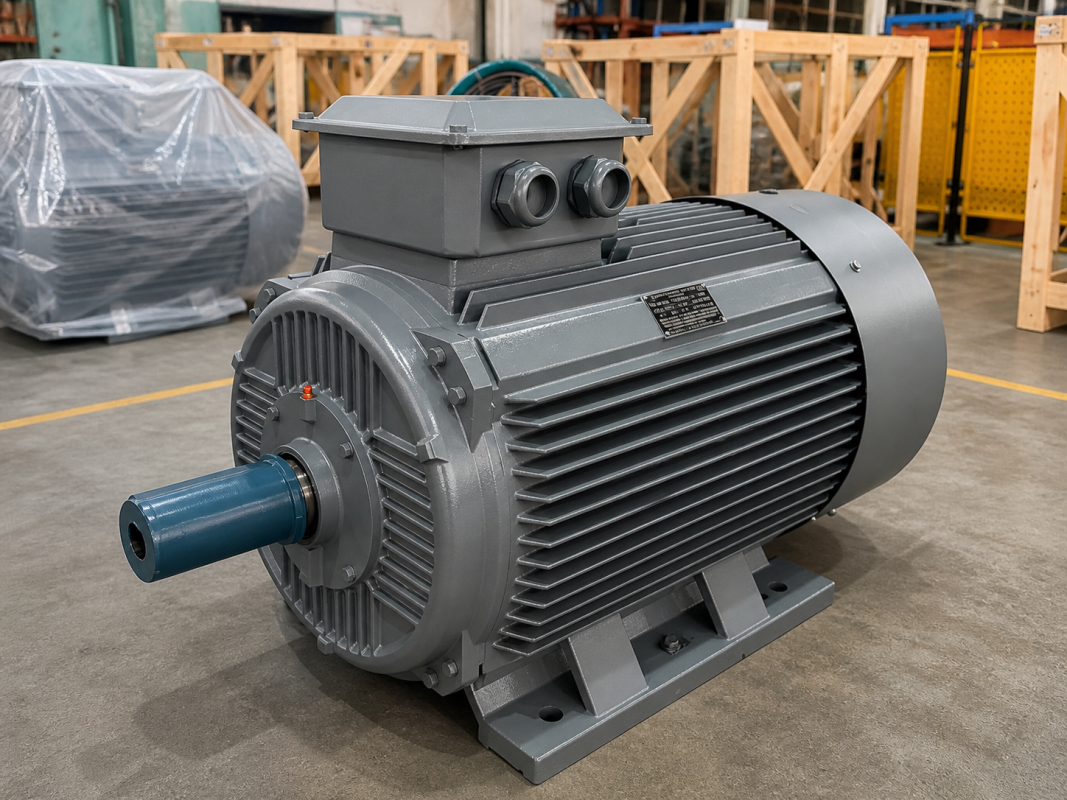

How quickly a motor can bring a load to the desired speed depends on a critical quantity that is often overlooked yet determines both the starting behavior and the life of the motor: the moment of inertia. Inertia is the resistance a rotating mass shows against a change in its speed. The higher the inertia of the load, the longer it takes to go from standstill to rated speed; throughout this long start, the motor draws high current, heats up and is stressed. At DRG Motor, when we recommend our IE3, IE4 and IE5 class AC induction motors, we evaluate the load inertia and the acceleration time as an inseparable part of the design. In this article we address in detail the moment of inertia, the GD² concept, the relationship between load inertia and motor inertia, how the acceleration time is calculated and the effect of high inertia on the choice of starting method.
What Is the Moment of Inertia (J)?
The moment of inertia is the quantity that expresses the resistance a body shows against a change in its speed of rotation. Its symbol is J and its unit is given as kilogram square meter (kg·m²). The greater the mass and the farther it is from the axis of rotation, the higher the inertia. The same mass shows much higher inertia when it is distributed toward the outer edge.
Inertia plays the role in rotational motion that mass plays in linear motion. Just as it is hard to accelerate a heavy mass, it is just as hard to start turning a high-inertia mass. For this reason, inertia is the fundamental determinant of starting behavior.
The GD² Concept and Its Relationship with J
In industry, the GD² (gyration effect) concept is frequently used to express inertia. GD² is based on the product of the body's weight and the square of its diameter. There is a fixed conversion relationship between J and GD²; both express the same physical reality, namely the resistance to rotation. While GD² was common in older catalogs and calculations, J is preferred in current engineering.
Load Inertia and Motor Inertia
In a drive system, two inertias exist together: the inertia of the motor's own rotor and the inertia of the driven load. What determines the acceleration time is the sum of these two inertias. The motor's rotor inertia is generally fixed and is given in the catalog; the load inertia, on the other hand, varies greatly according to the application.
The Inertia Character of Typical Loads
The table below summarizes the typical inertia magnitude relative to the motor inertia and the starting behavior of different load types. The values vary with the application but show the general tendency.
| Load Type | Load Inertia Relative to Motor Inertia | Typical Starting Behavior |
|---|---|---|
| Pump (centrifugal) | Low | Short, easy start |
| Conveyor | Medium | Medium-duration start |
| Industrial fan | High | Long, heating start |
| Centrifuge / decanter | Very high | Very long start, thermal risk |
| Flywheel | Extremely high | Controlled, gradual start |
As the table shows, low-inertia loads such as pumps do not stress the motor much, while high-inertia loads such as fans and centrifuges require a long start and thermal care.
Reducing Load Inertia to the Shaft
If the load is connected to the motor shaft not directly but through a gear or pulley, the load inertia must be reduced to the motor shaft. The reduction is done with the square of the transmission ratio. A high reduction ratio makes the load's inertia appear much smaller at the motor shaft; this is an effective way to drive high-inertia loads.
Why Is the Inertia Ratio Important?
The ratio of the load inertia to the motor inertia says much about the starting behavior of the system. If this ratio is very high, the motor struggles to accelerate the load and the start lengthens. Very low inertia ratios, on the other hand, can lead to a fast but sometimes uncontrolled start. A balanced inertia ratio provides a start that is both fast and safe.
How Is the Acceleration Time Calculated?
The acceleration time is the time required for the motor to bring the load from standstill to rated speed. The fundamental relationship is this: the acceleration time is found by multiplying the total inertia by the change in angular speed and dividing by the net accelerating torque. The net accelerating torque, in turn, is obtained by subtracting the load torque from the motor torque.
The Role of Net Accelerating Torque
To accelerate the load, the motor must overcome not only the load torque but also the inertia. The difference between the motor torque and the load torque is used to accelerate the inertia. The greater this difference, the faster the acceleration. If the difference approaches zero, the motor cannot accelerate the load and the start lengthens indefinitely. The power, torque and speed relationship forms the basis of this calculation.
The Torque-Speed Curve and Acceleration
The motor torque is not constant along the speed; it varies along the torque-speed curve. For this reason, the net accelerating torque is also different at each speed. The actual acceleration time is calculated according to the average net torque along the curve. The induction motor torque-speed curve shows how much accelerating torque is available in which speed region.
A Long Start at High Inertia
When the load inertia is high, acceleration with the same net torque takes much longer. A large fan, centrifuge or flywheel can require tens of seconds to reach rated speed from standstill. This long start is one of the most demanding operating moments for the motor.
The Thermal Consequences of a Long Start
During starting, the motor draws current many times the rated current. The longer the start, the longer this high current flows and the more heat accumulates in the winding. In high-inertia loads, repeated starts can carry the winding temperature to dangerous levels. Electric motor temperature control becomes vital at this point.
Starting Frequency and Inertia
Frequently stopping and restarting a high-inertia load forces the motor into a long, heating start each time. The number of starts permitted per unit time decreases together with the load inertia. In high-inertia applications that require frequent starts, the thermal capacity of the motor must be carefully calculated.
The Effect on Temperature and Insulation
The accumulated heat of long and frequent starts directly affects the insulation life. Every increase in the winding temperature shortens the life of the insulation. For this reason, in high-inertia applications the insulation class and the temperature-rise margin must be selected carefully. The electric motor insulation class is decisive in this respect.
The Effect on the Choice of Starting Method
High inertia directly determines the starting method. In direct-on-line starting the motor accelerates with full torque, but the high current during the long start can create a thermal problem. Soft starting limits the current but also reduces the torque, which lengthens the start even more in a high-inertia load. The right balance must be established carefully.
Soft Starting and Inertia
A soft starter protects the grid and the mechanical transmission by limiting the starting current. However, in high-inertia loads, the start lengthens due to the reduced torque, and the soft starter itself can be thermally stressed. The advantage of soft starting must be evaluated together with the load inertia.
Controlled Acceleration with a Frequency Inverter
A frequency inverter offers the most flexible solution for high-inertia loads. By adjusting the acceleration ramp, the starting time is brought under control, the starting current is limited and the motor maintains sufficient torque at every speed. This provides a great advantage in high-inertia applications both thermally and mechanically. Energy saving with a frequency inverter also offers a controlled start.
The High-Inertia Solution in Wound-Rotor Motors
In wound-rotor motors, by adding resistance to the rotor circuit, high torque and limited current are obtained at start-up. This is a classic way to accelerate high-inertia loads without stalling and without overheating. The comparison of squirrel-cage and wound-rotor induction motors addresses this solution in detail.
Inertia in Fan Applications
Large industrial fans are very high-inertia loads because of the mass and diameter of their blades. It takes a long time for a fan to reach full speed from standstill, and the motor is stressed throughout this time. In fan applications, the acceleration time and thermal capacity are at the center of motor selection.
Centrifuge and Flywheel Examples
Centrifuges and flywheels are the applications where inertia is most pronounced. A flywheel is deliberately designed with high inertia to store energy, which makes the start very long. In centrifuges, the inertia of the rotating mass directly determines the starting time and the motor stress.
Inertia in Crane and Lifting Applications
In lifting applications, both the inertia of the load and the lifting torque against gravity exist together. This requires both high starting torque and careful acceleration control. In the selection of a crane and lifting motor, inertia is a critical parameter for a safe start.
Inertia and Starting in Compressor Applications
In compressors, the inertia of the rotating parts, combined with the starting torque under pressure, creates a demanding beginning. The motor must both overcome the inertia and produce sufficient torque against the pressure. The article on compressor motor starting torque examines this combined difficulty.
Inertia and Motor Sizing
For a high-inertia load, the motor is sized not only according to the rated power but also according to the starting capacity. Sometimes a more powerful motor is selected solely to shorten the start and reduce the thermal load. Correct sizing must absolutely include the inertia calculation.
The Practical Importance of the Inertia Calculation
The inertia and acceleration-time calculation shows in advance whether the motor can start safely in the field. An incorrectly calculated start can result in overheating of the motor, tripping of the protection relay or the start never completing at all. For this reason, inertia is a silent yet decisive parameter of motor selection.
Inertia Management in Industrial Applications
Under heavy industrial conditions, high-inertia loads are frequently encountered. In our industrial electric motors range, the inertia, the starting frequency and the thermal capacity are evaluated together to determine the right motor and starting method.
Efficiency Class and Acceleration
High-efficiency IE4 and IE5 class motors produce fewer losses under the same load, which means less heating during starting. In high-inertia loads, a high-efficiency motor handles the thermal load created by the long start more comfortably. In addition, the torque reserve of high-efficiency motors can shorten the acceleration time by increasing the net accelerating torque. Thus efficiency provides an advantage not only in energy saving but also in terms of starting performance. Selecting the right efficiency class in a high-inertia application supports both a safe start and a long life for the motor.
The Relationship Between Inertia and Voltage
During the long start of a high-inertia load, high current is drawn from the grid for a long time. This high current can cause a voltage drop on the supply line. When the voltage drops, the motor torque decreases with the square of the voltage; that is, the motor weakens at the very moment it is most needed to accelerate the load. This situation lengthens the start even more and creates a vicious circle. For this reason, the capacity and voltage tolerance of the supply line must be carefully evaluated in high-inertia applications. The subject of voltage, frequency tolerance and derating is of critical importance in this respect.
The Relationship Between Inertia and Slip
During starting, the motor operates in the high-slip region, and every unit of torque produced in this region comes at the cost of high slip. Because the motor stays in this high-slip region for a long time with a high-inertia load, a significant amount of energy turns into heat in the rotor. When the start is complete, the motor passes into the low-slip region and begins to run efficiently. Slip in an induction motor is the fundamental concept for understanding the thermal load during acceleration.
The Effect of Inertia on Braking
Inertia makes not only starting but also stopping harder. A high-inertia load continues to coast for a long time after the power is cut. If this system must be stopped quickly and in a controlled way, the braking method must also be chosen according to the inertia. A mechanical brake, dynamic braking or the deceleration ramp of a frequency inverter must safely dissipate the rotational energy stored by the load. Trying to stop a high-inertia load suddenly stresses both the mechanical transmission and the motor. For this reason, stopping is as much a part of the inertia calculation as starting.
Inertia and Mechanical Transmission Elements
During the start of high-inertia loads, transmission elements such as couplings, belts, gears and shafts are subjected to large torque fluctuations. A sudden start can lead to fatigue in these elements and, over time, to failure. A gradual and controlled start protects not only the motor but also the entire mechanical transmission chain. For this reason, in high-inertia applications soft starting also extends the life of the transmission elements.
Correctly Gathering Inertia Data
A correct acceleration calculation is based on the real inertia data of the load. This data is obtained from the load supplier's catalog, from a geometric calculation or from measurement. A calculation made with missing or estimated inertia data can lead to unexpectedly long starts and thermal problems in the field. The DRG Motor engineering team carefully gathers the load inertia data in motor selection and verifies the acceleration time according to the real conditions.
The Relationship Between Pole Count and Acceleration
The pole count of the motor determines the rated speed to be reached, and this speed directly affects the acceleration time. In a high-speed two-pole motor, the change in angular speed is large, so the acceleration time lengthens for the same inertia. In low-speed multi-pole motors, the change in angular speed is small. The relationship of pole count and speed must be taken into account in the calculation of the acceleration time.
The Right Acceleration Design with DRG Motor
Inertia and acceleration time are two invisible yet decisive quantities of motor selection. High-inertia loads require a long start, an intense thermal load and a careful starting strategy. At DRG Motor, we recommend our IE3, IE4 and IE5 class AC induction motors according to the inertia and starting profile of your application; this provides a safe start, controlled acceleration and a long life. To determine the motor and starting solution most suitable for the inertia character of your application, you can contact the DRG Motor engineering team, and if you wish, you can better grasp the acceleration behavior by reviewing our article on the torque-speed curve.