 English
 Türkçe

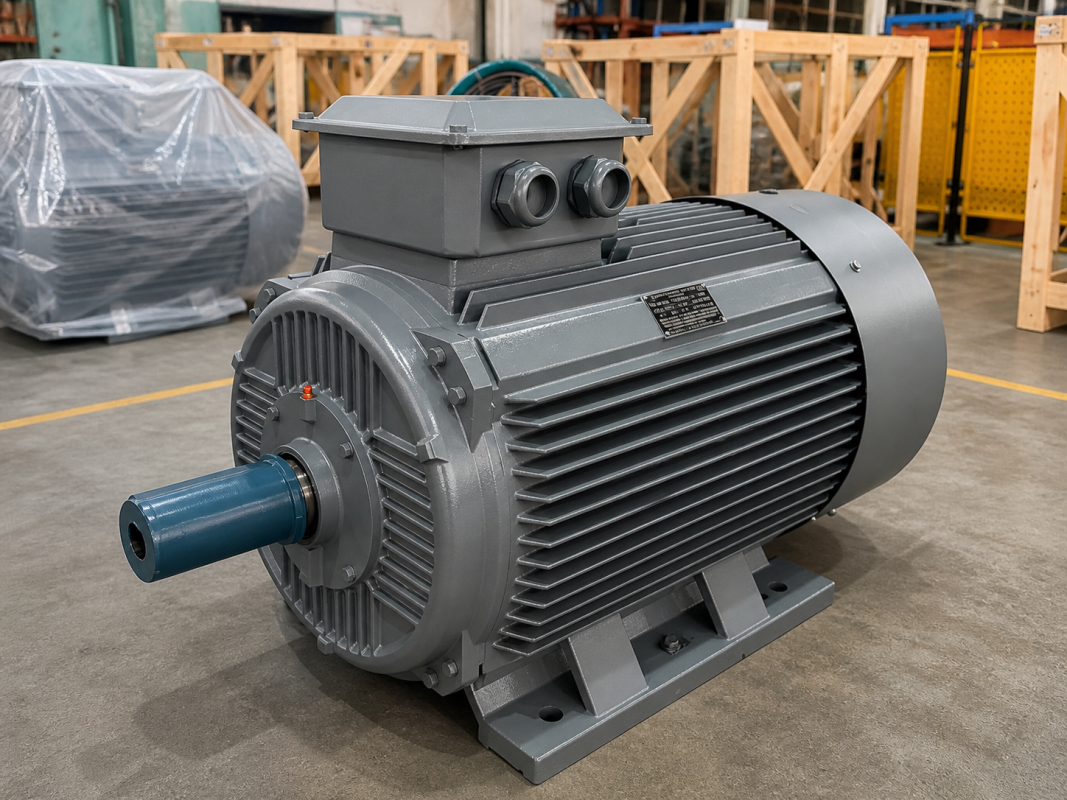

The healthy operation of an electric motor depends not only on the motor itself but also on the quality of the energy that feeds it. Under ideal conditions, the voltage coming from the grid should have a constant amplitude, be balanced and have a clean waveform. In real installations, however, this is often not the case: the voltage experiences sudden drops, the waveform becomes distorted, and unbalances arise between phases. All of these problems are gathered under the heading of "power quality" and directly affect the performance, lifespan and reliability of motors. In this article we examine what power quality means, the effects of voltage sags and harmonic distortion on motors, and the ways to improve power quality, drawing on DRG Motor's asynchronous motor experience.
What is power quality?
Power quality is a concept that describes how close the voltage and current in an electrical installation are to their ideal values. An ideal supply offers a voltage that is constant in amplitude, constant in frequency, balanced and a pure sine wave. In reality, voltage sags, harmonics, unbalances and transient overvoltages disrupt this ideal. Power quality problems affect motors as much as they affect sensitive equipment.
Why are motors affected by power quality?
Asynchronous motors are sensitive to the amplitude and waveform of the voltage. At low voltage the torque drops, with a distorted waveform additional losses and heating occur, and with an unbalanced supply efficiency loss is experienced. To examine the basic working principle of the motor, see our article on what an electric motor is; this makes it easier to understand power quality effects.
A motor converts the electrical energy it takes from the grid into mechanical energy through a magnetic field. This conversion requires the supply to be clean and stable. When the voltage is distorted, the magnetic field inside the motor is also distorted and the conversion becomes inefficient. Moreover, the motor cannot protect itself against these distortions; it continues to run under a distorted supply and wears out over time. For this reason, power quality is a factor that determines the health of the motor yet lies outside the motor. The healthier the installation's energy infrastructure, the longer and more trouble-free the motors run.
Main power quality problems
The main power quality problems relevant to motors are: voltage sag (dip), transient overvoltage, harmonic distortion, voltage unbalance and frequency deviations. Each creates a different adverse effect on the motor and is remedied by different measures.
What is a voltage sag?
A voltage sag is a short-term drop of the grid voltage below its rated value. It usually lasts a small fraction of a second, but despite this short duration its effect on motors is significant. Voltage sags can occur due to the energizing of large loads, faults on the grid or the effect of a nearby short circuit.
The effect of a voltage sag on the motor
The torque of an asynchronous motor is proportional to the square of the voltage. For this reason, a drop in voltage leads to a much more pronounced drop in torque. For example, when the voltage drops noticeably, the torque produced by the motor can fall to a level at which it cannot carry the load. In this case the motor slows down and may even stop.
This quadratic relationship explains why voltage sags are so dangerous for motors. A moderate drop in voltage turns into a much larger loss in torque. In a motor running close to its load, that is, with a low torque margin, this loss falls below the critical threshold and causes the motor to fail to lift the load. While high-inertia loads ride through short sags more easily, sensitive applications requiring continuous torque are seriously affected by these drops. For this reason, leaving a torque margin against expected voltage sags is a wise approach when sizing a motor.
Slowdown and stopping during a sag
A motor under load whose speed drops if it cannot produce enough torque during a voltage sag. If the sag is short, the motor can accelerate again; but if the sag is deep or long, the motor may stop. On a production line that must run continuously, such a stop can interrupt the entire process.
Restart after a sag
When the voltage returns to normal, motors that have slowed down or stopped try to accelerate again. During this restart, motors draw high current. If many motors in an installation restart at the same time, this collective current demand can stress the grid further and cause a secondary voltage drop. The starting current is therefore important for power quality as well.
This chain effect shows how power quality problems can feed themselves. The initial voltage sag slows the motors down, when the voltage returns they all try to start at once with high current, and this causes a new voltage drop. The most effective way to break this cycle is to control the restart of the motors. This control is easy in motors driven by a drive; in motors connected directly to the grid, a staggered-start logic must be established.
The contactor drop-out problem
Voltage sags also affect the contactor coils in the motor control. When the voltage drops below a certain level, the contactor can drop out and the motor can stop unintentionally. This leads to a production interruption even if the sag is very short. Contactor selection and control-voltage design are important in this respect; panel and contactor selection must be done correctly.
What is harmonic distortion?
Harmonics are unwanted voltage and current components that are multiples of the fundamental frequency. They disrupt the ideal sine wave and distort the waveform. Harmonics are generally produced by nonlinear loads; frequency inverters, rectifiers and electronic devices are the main sources. The topic of harmonic effects is becoming increasingly important in modern installations.
The additional heating harmonics cause in the motor
A motor fed by a voltage containing harmonics is subjected to additional losses due to the components outside the fundamental frequency. These losses produce extra heat in the windings and the iron core. As a result, the motor runs hotter at the same load. Continuous high temperature shortens insulation life and can lead to early motor failure.
High-frequency harmonic components further increase the losses by accentuating phenomena such as the skin effect in the motor's conductors. In addition, harmonics can cause additional torque pulsations and vibration in the motor; this both accelerates mechanical wear and increases noise. An important consequence of the temperature rise is an increase in the aging rate of the insulation material. As a general rule, a continuous rise in winding temperature corresponds to a noticeable shortening of the motor's expected life. For this reason, running motors that operate in harmonic-rich environments at a somewhat lower load (derated) can be a way to preserve life.
The effect of harmonics on efficiency
The additional losses lead not only to heating but also to a drop in efficiency. A motor operating in a harmonic environment draws more energy from the grid to do the same work. This raises energy costs in the long run. For this reason, reducing harmonics at the source is important for both motor health and energy efficiency.
The relationship between the frequency inverter and harmonics
Frequency inverters offer a great advantage in terms of energy saving and speed control; however, by the nature of their operating principle, they can introduce harmonics into the grid. For this reason, while energy saving is achieved with a frequency inverter, harmonic management must also be planned. This balance can be struck with correct filtering measures.
Voltage unbalance
In a three-phase system, the voltage difference between phases leads to serious problems in the motor. Even a small unbalance can noticeably raise the winding temperature and reduce efficiency. The effect of voltage unbalance is one of the most frequently overlooked yet most harmful dimensions of power quality.
Sources of unbalance
Voltage unbalance generally arises from loads not being distributed equally across the phases. The concentration of single-phase loads on one phase disrupts the balance between phases. In addition, loose connections and differences in cable resistances also contribute to unbalance. Distributing loads evenly across the phases greatly reduces this problem.
Transient overvoltages
Contrary to a voltage sag, in some cases the voltage can suddenly rise above its rated value. The disconnection of large loads or lightning-induced surges can lead to this condition. Overvoltage stresses the motor insulation and accelerates the aging of the insulation in the long run. Protection elements take measures against these surges.
Very short but high-amplitude voltage transients in particular are an insidious threat to motor insulation. These surges may not damage the motor immediately on their own, but as they recur they accumulate micro-damage in the insulation. Over time these damages combine, leading to insulation breakdown and a short circuit. In motors driven by drives, the fast switching at the drive output can also cause voltage spikes at the motor terminals; in this case an appropriate motor insulation class and, where needed, output filters are used.
Summary of power quality problems
| Problem | Effect on the motor | Measure |
|---|---|---|
| Voltage sag | Torque drop, slowdown, stopping | Supply reinforcement, staggered restart |
| Harmonic distortion | Additional heating, efficiency loss | Filtering, correct drive selection |
| Voltage unbalance | Overheating, efficiency loss | Load balancing, connection check |
| Overvoltage | Insulation stress | Protection devices, surge arrester |
The role of protection relays in power quality
Modern motor protection relays can monitor not only overload but also voltage sag, unbalance and phase loss. In phase loss and unbalance conditions, they prevent damage by taking the motor out of service. These relays are the first line of defense against power quality problems.
Grounding and power quality
Good grounding is important for both safety and power quality. Proper grounding reduces the effect of noise and leakage currents and ensures the correct operation of the protection elements. A solid grounding arrangement lies at the foundation of power quality improvement work.
Ways to improve power quality
There are several basic approaches to improving power quality: reinforcing the supply line, distributing loads evenly across the phases, using harmonic filters, performing reactive power compensation and selecting protection elements correctly. Applying these measures together both extends motor life and increases operational continuity.
Improvement work should always begin with a correct diagnosis of the problem. For example, when the real problem is harmonic distortion, reinforcing the supply line does not give the expected result; similarly, fitting a harmonic filter is not a solution to an unbalance problem. For this reason, measurement is done first, the dominant problem is identified, and the appropriate measure is selected for it. Since most installations have more than one problem at once, the solution generally requires applying several measures together. The interaction between the measures must also be considered; for example, a resonance risk can arise between compensation capacitors and harmonics.
Reactive power and compensation
Asynchronous motors draw reactive power in order to operate. This reactive power loads the grid unnecessarily and contributes to voltage drops. Compensation, by supplying the reactive power locally through capacitors, reduces the grid load and improves voltage quality. However, the interaction between compensation and harmonics must be managed carefully.
Supplying reactive power locally reduces the current on the supply line; this in turn lessens the voltage drop along the line and allows a higher voltage to reach the motor terminals. Thus compensation can indirectly mitigate the effects of voltage sags as well. However, in a harmonic-rich environment, compensation capacitors can resonate with certain harmonic frequencies and raise the voltage instead of lowering it. To manage this risk, detuned (reactor-supported) compensation panels are preferred in installations with harmonics. For this reason, compensation design must be considered together with power quality as a whole.
Staggered restart strategy
After a voltage sag, the simultaneous starting of all motors can lead to secondary problems. For this reason, in large installations the motors are made to restart in stages, in a certain order. This strategy prevents the voltage drop caused by the collective starting current and allows the system to recover more smoothly.
Power quality in sensitive applications
Some production processes cannot tolerate even a short motor stop. In these applications that must run continuously and without interruption, power quality becomes even more critical. In applications requiring continuous flow such as conveyor systems, a voltage sag can stop the entire line.
Power quality management in industrial installations
In general, in installations using industrial electric motors, power quality should be addressed as a separate engineering subject. The installation's load profile, the number of motors and their sensitivity determine the necessary power quality measures. A well-designed power quality management greatly reduces unexpected stops.
Monitoring and measurement
The first step in solving power quality problems is to measure and monitor them. Regularly measuring parameters such as voltage, harmonic level and unbalance allows hidden problems to be noticed early. Improvements made without measurement data often fail to reach the goal.
Since power quality problems are often intermittent and transient, they are difficult to catch with an instantaneous measurement. For this reason, continuously recording measurement devices reveal when and under what conditions the problems occur. For example, a voltage sag occurring at the moment a particular machine is energized can only be correlated through continuous recording. This data makes it possible both to find the source of the problem and to verify whether the applied improvement works. Measurement is both the starting step and the verification step of power quality management.
The returns of correct power quality management
A well-managed power quality ensures that motors run cooler, that efficiency is preserved, that unexpected stops are reduced and that equipment life is extended. Power quality is an invisible infrastructure element that directly affects every motor. Investment in it is an investment in the health of the entire motor fleet.
DRG Motor for power-quality-resilient motor solutions
DRG Motor evaluates its asynchronous motors taking real installation conditions into account. DRG Motor offers engineering support for motor selection resilient to voltage sags and harmonic-rich environments, and for correct protection and drive compatibility. To determine together the motor best suited to your installation's power quality conditions and to achieve uninterrupted operation, get in touch with the DRG Motor team.