 English
 Türkçe

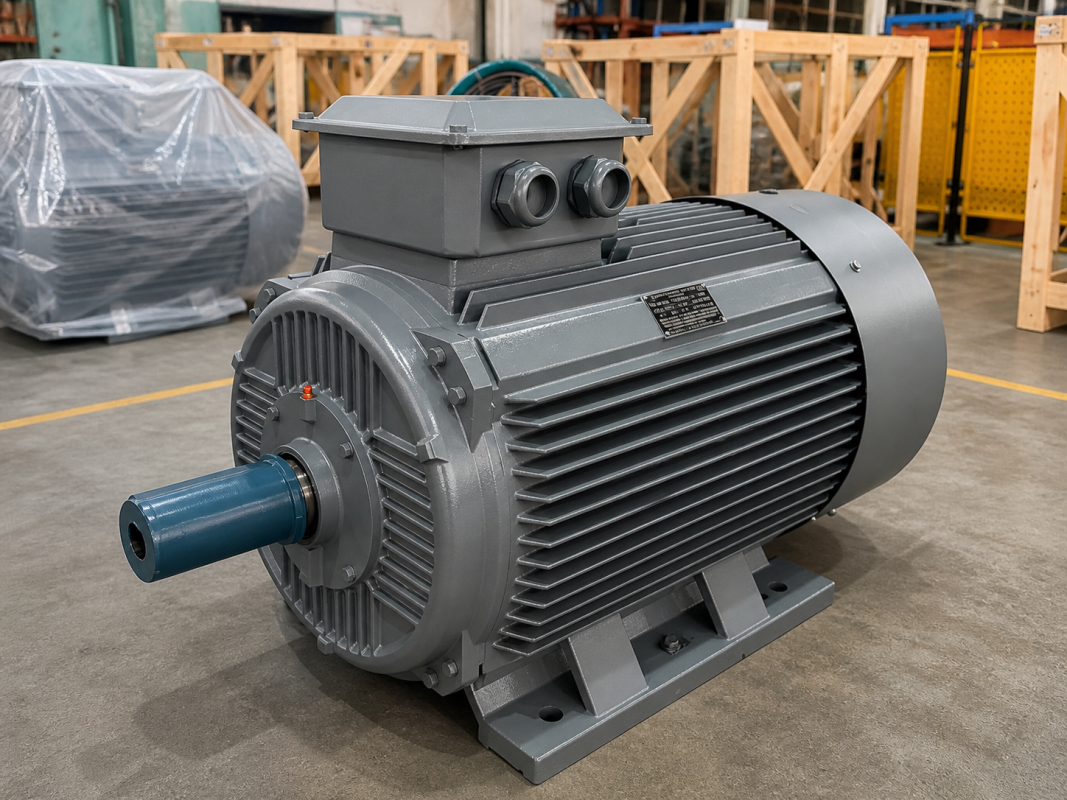

When an electric motor is fed from the mains, the high current it draws at the moment of starting often goes unnoticed, because the city grid behaves like an almost unlimited source. But when you feed the same motor from a generator or a transformer of limited power, the situation changes completely. The motor drawing several times its rated current at the instant of starting can cause the generator to stall, the voltage to collapse, or the transformer to be overstressed. In this article we cover what to watch for when powering a motor from a genset and a transformer: the effect of inrush current on source size, voltage dip, generator overloading, reducing the load through the starting method, the short-circuit power of the transformer, and correct sizing. Our goal is to show the engineer who wants to commission a motor safely and stably both the source of the problem and the practical solutions clearly.
Why inrush current is so high
In the instant an induction motor goes from standstill to full speed, the rotor is not yet turning, so the motor appears almost as a short circuit to the supply. For this reason, a direct-on-line started motor draws roughly six to eight times its rated current. This current lasts only a few seconds, but that short period is extremely demanding for a limited source. For more detailed information about the nature and magnitude of inrush current, the article on motor starting and inrush current is a comprehensive reference.
The difference between the grid and a limited source
The city grid is a vast source next to a single motor's inrush current; that is why the voltage hardly drops at all during starting. A generator or a small transformer, however, may have a power comparable to the motor. In that case the motor's inrush current strains the source and the voltage collapses noticeably. This is precisely where the essence of the limited-source supply problem lies.
Voltage dip and its consequences
The high current drawn at starting creates a voltage drop across the internal resistance of the source, and the voltage at the motor terminals falls. As the voltage falls, the starting torque the motor produces also falls, because torque is proportional to the square of the voltage. So if the voltage drops by twenty percent, the starting torque decreases by about a third. In this case the motor cannot lift the load, accelerates slowly, draws high current for longer, and this lowers the voltage even further; a vicious circle forms.
The generator's response to the motor
A generator cannot respond to sudden load increases as quickly as the grid. When the motor switches in, the generator's voltage regulator and speed governor try to keep up with the sudden current. During this, both voltage and frequency drop temporarily. If the generator is not large enough to supply the motor's inrush current, the voltage cannot recover, the motor cannot start, and the generator may trip out on protection.
Sizing the generator correctly
As a practical rule, to start a direct-on-line motor without trouble, the generator's power must be selected significantly above the motor's power. The reason is not the generator's continuous power limit but its current capacity at the instant of starting. A generator may comfortably carry its rated load yet be unable to supply the same motor's inrush current. For this reason, in generator selection the determining factor is not continuous power but the starting behavior of the largest motor.
Reducing the load through the starting method
When supplying from a limited source, the most effective solution is to reduce the motor's inrush current from the start. Using a softened starting method instead of direct-on-line dramatically reduces the sudden load the source sees. Thus the same motor can be started safely with a smaller generator or transformer. The table below compares the main starting methods and their effect on the source.
| Starting method | Inrush current (approx.) | Effect on source |
|---|---|---|
| Direct-on-line | 6-8 times rated | Most demanding; requires a large source |
| Star-delta | ~2-3 times rated | Reduces inrush to a third; starting torque also drops |
| Soft starter | Adjustable, ~2-4 times | Limits current gradually; reduces voltage dip |
| Frequency inverter (drive) | Close to rated | Lowest inrush current; least strain on the source |
Star-delta starting
The star-delta method first runs the motor in star connection at reduced voltage and, after it reaches a certain speed, switches it to delta connection. In this way the inrush current is reduced to about a third compared with direct-on-line. The cost is that the starting torque also drops by the same ratio; for this reason the method may be inadequate in applications that start under heavy load. On pumps and fans that start unloaded or lightly loaded, however, it is quite effective.
Soft starter
A soft starter raises the supply voltage gradually, starting the motor without jolts. By keeping the inrush current within an adjustable limit, it brings the sudden load on the generator and transformer under control. Because it also reduces mechanical wear, it is preferred in belt-pulley and coupled systems. However, a soft starter too reduces torque along with voltage; on very heavy loads it has its limits.
Starting with a frequency inverter
The method that provides the lowest inrush current is the frequency inverter. Because the inverter starts the motor from a low frequency and slowly raises it to rated, the inrush current stays nearly at the rated current level. This is the most comfortable option for a limited generator or transformer. The inverter also offers additional advantages such as torque control, speed adjustment and energy saving; in this respect it is a versatile solution in many applications.
Step starters and the resistor method
Alongside star-delta and electronic methods, there are also classic ways to limit inrush current. Starting resistors or reactors connected in series with the motor lower the voltage at starting to limit the current and are gradually switched out as the motor speeds up. These methods are simple and rugged; they may still be preferred especially in dusty and hot environments where electronic equipment struggles. The cost, again, is a drop in starting torque.
The importance of starting time
In limited-source supply design, not only the magnitude of the inrush current but also how long it flows is important. A load with high moment of inertia (a large fan or a flywheel) accelerates slowly and keeps the motor at high current for a long time. This long duration heats both the motor and the source. For this reason, on high-inertia loads, choosing a method that reduces inrush current protects not only the source but the motor itself.
The short-circuit power of the transformer
When supplying from a transformer, the determining quantity is the transformer's short-circuit power. This value shows how well the transformer can withstand sudden current demands. A transformer with high short-circuit power supplies the motor's inrush current without dropping the voltage too much. On a transformer with low short-circuit power, the same motor causes a noticeable voltage collapse. For this reason, in transformer selection, not only the kVA power but also the short-circuit impedance must be considered.
The relationship between transformer kVA and motor power
A common misconception is to assume that as long as the transformer's kVA power is greater than the motor's kW power, everything will be fine. But the determining factor is not continuous power, but the voltage drop the sudden current at starting creates in the transformer. A transformer that comfortably carries the continuous load can cause a noticeable voltage collapse during the direct start of a large motor. For this reason, when assessing transformer-motor compatibility, the starting scenario must always be considered separately.
Avoiding voltage unbalance
When supplying from a generator and transformer, balanced loading of the three phases is also important. Uneven distribution of single-phase loads makes the voltage the motor sees differ between phases, and this unbalance causes extra heating in the motor. On a limited source this effect is more pronounced. Distributing loads evenly across the phases protects both the source and the motor and supports efficient operation.
The effect of voltage dip on other loads
The voltage dip that occurs during a motor's start affects not only that motor but all other devices fed from the same busbar. Flickering in lighting, resets in sensitive electronics, even the stopping of other motors can be seen. For this reason, a large motor's starting method concerns the electrical stability not just of that motor but of the entire facility.
Protection settings matched to starting
A frequent problem in limited-source supply is that protection relays mistake the inrush current for a fault and cut off the motor before it can even start. Overcurrent protection must be set to allow the normal inrush current and its duration to pass, but to trip quickly in a real fault. When a soft starter or inverter is used, the inrush current drops, so the protection setting can use a narrower band accordingly; this sharpens fault detection.
Motor priority in a backup power scenario
On a backup generator that switches in when the mains fails, all loads returning at the same time strains the generator. Here a smart load management brings critical motors in first and secondary loads later. Building a step-loading logic into automatic transfer panels ensures the backup generator both starts the motors and stays stable. Without this planning, even a correctly sized generator can stall in the first instant.
The starting sequence of multiple motors
If there are multiple motors fed from the same generator or transformer, trying to start them all at once will certainly exceed the source. The solution is to bring the motors in sequentially, with a delay between them. Starting the largest motor first and adding the others after it has settled keeps the voltage dip manageable. A staggered starting logic is the key to being able to supply many motors with a limited source.
Inverter compatibility with the generator
Because frequency inverters reduce inrush current, they work very well with a generator; however, inverters also feed harmonic current back into the supply. On a small generator these harmonics can distort the voltage waveform and strain the regulator. For this reason, in an inverter-generator combination, it is important to choose a generator suited to harmonics or to use a filter where necessary. When set up correctly, this pair offers the most efficient solution with a limited source.
The difference between cold and warm starting
A motor's starting behavior also depends on the state of the load it drives. Starting a loaded, stationary conveyor or a full pump demands far more torque, and therefore a longer period of high current, than starting an empty fan. In limited-source supply design, the motor's most demanding starting scenario (cold start with the heaviest load) must be the basis; the worst case, not the best case, is the determining factor.
The power factor's effect on the source
At the instant of starting, a motor draws a low-power-factor, largely inductive current. This reactive current directly strains the voltage regulation of the generator and transformer, because an inductive load tends to lower voltage. Although power factor correction capacitors help in continuous operation, the starting moment itself is low power factor, and this is a reality that must be taken into account in source sizing. The right starting method also softens this reactive surge.
Not forgetting cable and line impedance
Part of the voltage dip comes not from the source but from the long, thin cable between the source and the motor. The high current at starting creates an additional voltage drop across the cable resistance. On a motor at a long distance, choosing a sufficiently large cable cross-section can be as important as enlarging the source. When sizing, the source, cable and motor must be evaluated as a whole.
The effect of environmental conditions on starting
In hot and high-altitude environments, both the generator and the transformer drop below their nameplate power, because cooling becomes harder. Likewise, a load whose oil thickens in cold weather puts the motor into a more demanding start. In limited-source supply design, ambient temperature, altitude and seasonal conditions must not be overlooked, because these factors can simultaneously worsen both the power the source can deliver and the power the motor demands at starting.
Generator or continuous motor drive
In some applications, instead of using a genset to drive a machine, using an electric motor directly is both more efficient and a lower-maintenance solution. For this comparison, the article on electric motor instead of generator drive covers in detail which solution is suitable in which case. In places with grid access, an electric motor is usually the more sensible choice.
Frequency recovery and regulator speed
In generator supply, frequency is as important as voltage. When the motor switches in, the sudden load momentarily lowers the speed of the engine driving the generator, and the frequency fluctuates briefly. The faster the generator's speed governor recovers, the shallower the frequency dip. In a facility with frequency-sensitive loads, the generator's regulator performance must be assessed as carefully as the motor's starting.
A pre-commissioning checklist
Before commissioning a motor from a limited source for the first time, a few checks prevent most problems. The source's power and short-circuit capacity must be compared with the motor's starting need, the starting method chosen according to the load, the cable cross-section verified according to distance, and protection settings adjusted so that they do not accidentally cut the inrush current. This preparation prevents annoying situations such as the source stalling on the first attempt.
DRG Motor at your side for safe supply
At DRG Motor, we treat the compatibility of the AC induction motors we manufacture with generators, transformers and drives as part of the design. In a facility to be fed from a limited source, motor selection, starting method and correct sizing should often be handled not one by one but as a whole. For motor selection suited to your generator or transformer, the most appropriate starting method and trouble-free commissioning, you can contact the DRG Motor expert team. On this subject, our industrial electric motors and inrush current content will also guide you.