 English
 Türkçe

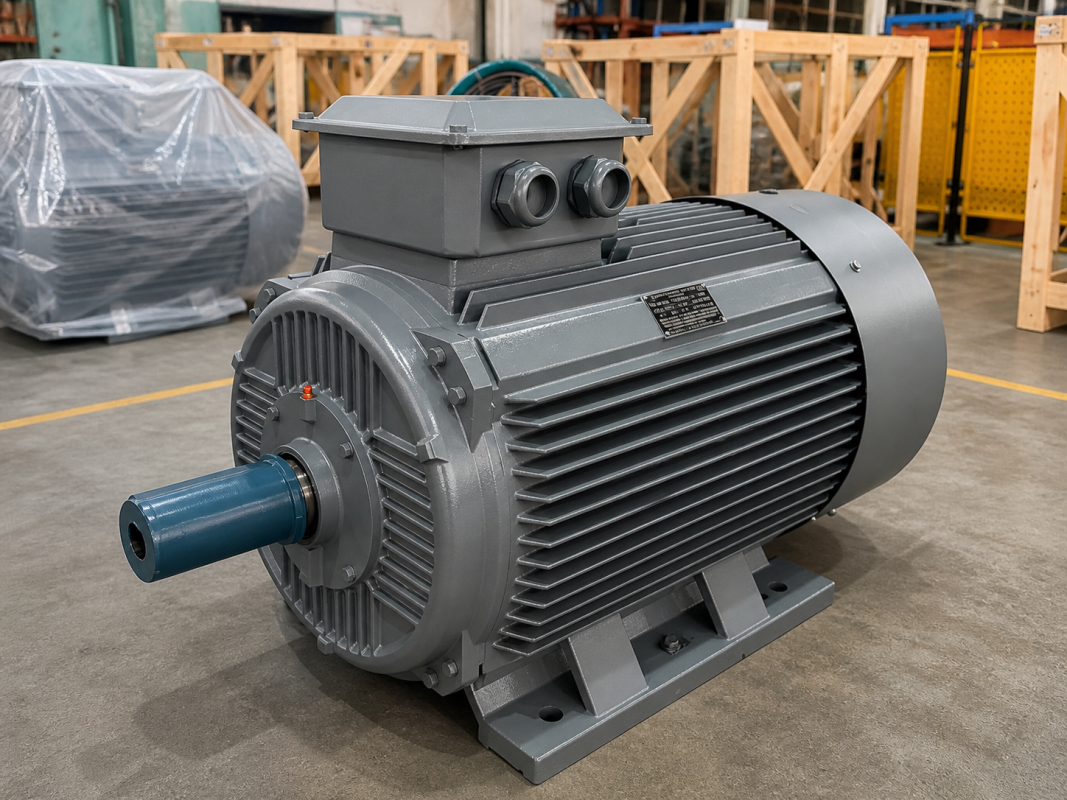

The most honest information about an electric motor's health usually comes from its vibration. When bearings begin to wear, when rotor imbalance develops, or when fasteners loosen, the motor reveals it first through its vibration signature; a rise in temperature or a current anomaly typically arrives later. In the traditional approach a technician walks the plant periodically, presses a handheld instrument against the motor, and captures a few seconds of measurement. This method served industry for decades, but it had two fundamental weaknesses: faults that developed between measurement intervals could be missed, and motors in hard-to-reach locations could not be tracked regularly. Wireless vibration sensors emerged precisely to close this gap. At DRG Motor we care deeply about the field reliability of our IE3, IE4 and IE5 class asynchronous motors throughout their service life, which is why we want to help make condition monitoring technology properly understood.
Why vibration is the most reliable health indicator
Every rotating machine vibrates; the question is not whether vibration exists but what its character is. A healthy motor produces a stable vibration with a specific amplitude and frequency pattern. When a fault begins to develop, this pattern changes: energy concentrates at certain frequencies, amplitude rises, or new harmonics appear. These changes usually begin long before the motor shows any externally noticeable loss of performance.
Vibration is so valuable because it reflects mechanical events directly. A microscopic pit on a bearing's inner race produces a small impact at every pass, and that impact leaves a distinctive trace in the vibration spectrum. Likewise, rotor imbalance creates a clear peak at the rotation frequency. This direct relationship makes vibration analysis the backbone of predictive maintenance programs.
The hidden cost of periodic measurement
A measurement taken by a technician carrying a handheld device is valuable, but it is a single snapshot. The motor may look fine at that instant; yet within the four-week gap between two measurements a bearing can degrade rapidly. This blind spot is critical especially for fast-developing faults.
The second problem with periodic measurement is the repeatability of measurement conditions. The angle at which the device touches the motor, the load condition, and the motor temperature can differ each time, which complicates trend analysis. Continuous monitoring, because it always collects data from the same point using the same method, produces a far more consistent trend.
How a wireless sensor architecture works in broad terms
A wireless vibration monitoring system essentially consists of three layers. The first layer is the sensors fixed to the motor housing. These sensors are usually accelerometer-based and convert vibration into an electrical signal. The second layer is the gateway that collects and transmits data from the sensors. The third layer is the software platform where data is stored, processed, and visualized.
The greatest advantage of being wireless is ease of installation. Instead of running cables, cutting cable trays, and carrying signals over long distances, the sensor is mounted directly on the motor and transmits data over the air. This significantly reduces installation cost and time, especially in facilities where many motors must be monitored.
Where and how should the sensor be mounted?
The quality of vibration data depends largely on the mounting point. The ideal is to fix the sensor to a rigid metal surface as close as possible to the source of vibration; this is usually the region of the bearing housing. Soft surfaces, paint layers, or loose connections damp high-frequency vibrations and cause early fault indications to disappear.
Triaxial sensors capture vibration in radial and axial directions simultaneously, so they provide multidirectional information from a single mounting point. Setting the mounting orientation and axis definition correctly in the monitoring software is important so that subsequent analyses remain meaningful.
The vibration signature of bearing failure
Bearing failures are among the most common causes of motor failure and, fortunately, among the faults with the clearest signature in vibration analysis. The inner race, outer race, balls, and cage of a bearing have different pass frequencies. Peaks appearing at these frequencies can pinpoint exactly which component is degrading.
In the early stage these indications appear in the high-frequency region as low-amplitude but regular impacts. As the fault progresses, amplitude rises and harmonics multiply. Tracking this progression lets the maintenance team decide between "intervene now" and "replace at the next planned shutdown."
How to distinguish imbalance from misalignment
Imbalance and misalignment (coupling/shaft offset) are two frequently confused problems, but their vibration signatures differ. Imbalance typically produces a dominant radial vibration at the rotation frequency. Misalignment shows up as a pronounced component at the second harmonic of the rotation frequency and usually as increasing vibration in the axial direction.
Being able to make this distinction leads to the correct corrective action. A misdiagnosed imbalance problem leads to unnecessary balancing efforts while the real cause, misalignment, continues. We address the mechanical side of this topic in more detail under reducing motor noise and vibration.
Mechanical looseness and structural problems
Loosening of connection bolts, gaps at foot mountings, or weak mounting to the foundation appear in the vibration spectrum as numerous harmonics of the rotation frequency. Mechanical looseness is an insidious problem; it begins as a slight noise, then feeds on itself, worsening rapidly and damaging other components.
Continuous monitoring catches this harmonic pattern created by looseness early, preventing a problem that could be solved with a simple tightening from turning into a major failure.
Vibrations of electrical origin
Not every vibration is mechanical in origin. Electrical faults such as stator winding problems, rotor bar breaks, and air-gap eccentricity also produce distinctive vibration signatures. A broken rotor bar in particular appears as sideband components around the line frequency. In the detailed detection of such faults, the MCSA broken rotor bar diagnosis method complements vibration analysis.
Using vibration and current analysis together makes it easier to separate mechanical from electrical faults and improves diagnostic reliability.
Alarm levels and trend analysis
The power of wireless monitoring lies not in a single measurement but in the trend over time. The system learns a baseline for each motor and raises a warning if the overall vibration level deviates from this line. A two-stage alarm structure is generally used: an "alert" threshold and an "alarm" threshold.
Trend charts show how fast a fault is developing. A slowly rising trend says there is time to intervene at a planned shutdown; a steep rise says urgent attention is needed. This information transforms maintenance planning from guesswork into a data-driven discipline.
Monitoring together with temperature
Many wireless vibration sensors also measure surface temperature. Evaluating vibration and temperature data together increases diagnostic power. For example, a simultaneous rise in both vibration and temperature is a strong indicator of an advanced bearing fault. We address this topic in an integrated way under electric motor temperature control.
On which motors is wireless monitoring a priority?
Fitting a sensor to every motor may not be economical, so prioritization matters. A criticality analysis asks two questions: will production stop if this motor fails, and is the probability of failure high?
Large, continuously running, non-redundant motors at the heart of a production line come first. Motors that are hard to reach, at height, or in hazardous areas also benefit most from wireless monitoring, because manual measurement at these points is laborious and risky.
Integration into a predictive maintenance program
Wireless sensors do not create value on their own; real value emerges when the data they collect is connected to a maintenance workflow. Automatically generating a work order when an alarm is triggered, notifying the relevant technician, and making historical data accessible for diagnosis turn the system into a genuine predictive maintenance tool.
This integration is part of a broader maintenance strategy. Combining vibration data with energy monitoring and regular maintenance steps produces a holistic health picture of the motor.
Interpreting the data: how far does software go?
Although modern monitoring software offers automatic diagnosis, the value of an experienced eye in critical decisions cannot be denied. Software can flag a peak, but interpreting whether it stems from a real fault or a change in operating conditions often requires human experience. The best results come where automated analysis and expert judgment meet.
Reducing false alarms
One of the biggest practical problems of continuous monitoring systems is false alarms. Load variations, transient operating conditions, or incorrect threshold settings can lead to unnecessary warnings. This causes what is called "alarm fatigue," where the team begins to stop taking even real warnings seriously. Carefully setting thresholds according to the motor's actual operating profile reduces this risk.
Battery life and maintenance-free design
Most wireless sensors run on batteries, and long battery life is critical for field use. A well-designed system lets the sensor operate for years without maintenance. There is a balance between transmission frequency and battery life; very frequent transmission provides more detailed data but drains the battery quickly.
The added value of condition monitoring on efficient motors
IE4 and IE5 class high-efficiency motors represent a higher initial investment; condition monitoring is a natural complement to protecting that investment. The unexpected failure of an efficient motor is costly both in replacement cost and in lost production. On our high-efficiency electric motors page we detail the advantages these motors offer; condition monitoring ensures those advantages last for the lifetime of the motor.
Questions to ask before installation
Before starting a monitoring project, clear objectives are needed. Which fault types do we want to catch? How many motors will be monitored? By whom and how often will the data be interpreted? How will it integrate with the existing maintenance system? The answers to these questions determine the right sensor density and system architecture.
Typical gains in the field
When properly applied, wireless vibration monitoring delivers a marked reduction in unplanned downtime, lower maintenance costs, and extended motor life. Perhaps most importantly, it lets the maintenance team move out of "firefighting" mode into planned, proactive work. This cultural shift is as valuable as the technology itself.
Why sampling frequency matters
How often and at what resolution a vibration sensor samples directly determines which faults it can see. Catching high-frequency bearing faults requires a sufficiently high sampling frequency; otherwise early indications are missed entirely. Low-frequency problems such as imbalance, by contrast, can be seen comfortably even with lower sampling. When designing the system, the frequency range of the faults to be caught must overlap with the sensor's capability.
This balance is also tied to battery life and data volume. Continuous high-resolution measurement provides the richest data but is the most expensive option. Many facilities adopt a hybrid approach that combines periodic high-resolution full-spectrum measurement with frequent overall-level measurement.
Time-domain and frequency-domain analysis
Vibration data is examined from two basic perspectives. Time-domain analysis shows the vibration waveform as it is and is powerful at capturing impulse-like events and impacts. Frequency-domain analysis (spectrum) separates the signal into its component frequencies and reveals where energy concentrates; this is the key to identifying the source of a fault. A mature monitoring program uses both approaches.
Advanced techniques such as envelope analysis are particularly effective at pulling early-stage bearing faults out of the noise. These techniques catch indications that a simple overall-level measurement might miss.
The effect of operating conditions on the data
Vibration data carries meaning not in isolation but together with operating context. The same motor produces different vibration at different load, speed, or temperature. Therefore, when interpreting data, you need to know the motor's current operating state. This is especially important on motors running under speed control, because the rotation frequency changes constantly and fixed thresholds can become meaningless.
Some systems overcome this by recording speed and load information at the moment of measurement alongside the vibration data. Measurements under similar operating conditions are then compared within their own group, and it becomes clear whether the trend reflects real degradation or merely a change in operating point.
Reliability in wireless communication
A natural concern with wireless systems is the reliability of data transmission. Metal-dense industrial environments can hinder signal propagation. Well-designed systems carefully plan gateway placement and signal path to minimize data loss. Sensors that buffer data locally during brief communication interruptions and send it once the connection returns ensure that no measurement is lost.
The advantage of scalability
In wired systems, every new sensor means additional cabling cost; in wireless systems, adding one more sensor usually consists only of mounting it and introducing it to the network. This scalability makes it easy for a monitoring program to grow over time. Facilities typically start with their most critical few motors and gradually expand the scope as they see the value.
The value of data history
An often-overlooked benefit of continuous monitoring is the rich data history that accumulates over time. The vibration history of a motor built up over months and years is an invaluable resource for understanding the behavior of similar motors and predicting future faults better. This accumulation makes maintenance decisions progressively more accurate.
Special importance in fan and compressor applications
Some applications benefit disproportionately from vibration monitoring. Fan and blower systems are prone to developing imbalance over time due to dust accumulation on the blades; vibration monitoring catches this buildup early. We address the special requirements of these applications under fan and blower motor selection. In compressor systems, vibration can be an early herald of both mechanical wear and process-related problems.
DRG Motor for reliable motor infrastructure
Wireless vibration sensors are a powerful tool that makes a motor's health transparent; but for this monitoring to create value, the monitored motor must have been soundly designed from the start. Balanced rotors, quality bearing housings, and meticulous manufacturing tolerances are the foundation of a low and stable vibration baseline. At DRG Motor we design our IE3, IE4 and IE5 class asynchronous motors with the goal of both high efficiency and long-lived mechanical stability. You can explore our DRG electric motors and contact us for a motor selection suited to your facility's condition monitoring strategy. When a robust motor meets an intelligent monitoring system, your production becomes predictable and uninterrupted.