 English
 Türkçe

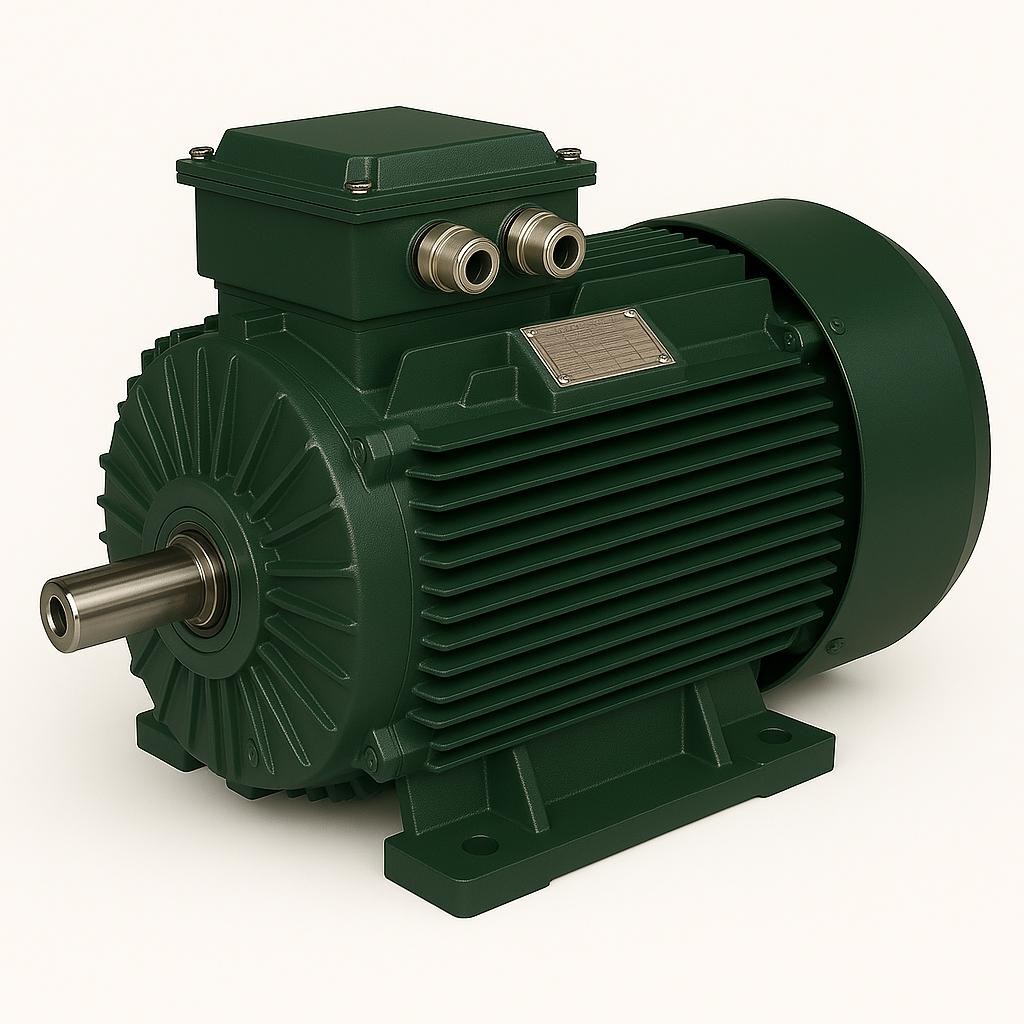

The efficiency value printed on an electric motor's nameplate is a design target achieved under ideal conditions. If you want to learn how efficiently that motor actually runs in the field, you have to measure it. Efficiency measurement quantifies how much of the electrical power the motor draws from the supply it delivers to the shaft as mechanical power. This seemingly simple question hides a serious measurement technique behind the door: for an accurate result, quantities such as voltage, current, power factor, speed and torque must be read simultaneously and precisely. In this article we cover why motor efficiency is measured, the direct and indirect measurement methods, the application area and accuracy of each, the difference between field and laboratory conditions, and the sources of error. Our goal is to show concretely how a maintenance or energy engineer can reach a reliable efficiency result with the instrument in hand.
Why efficiency is measured
When a motor's efficiency drops by a few percentage points, the bill grows silently throughout the year. On a large, continuously running motor, this difference can exceed the cost of a new motor within a few years. For this reason, efficiency measurement is not just a technical curiosity but a decision that directly concerns operating cost. Furthermore, measuring the efficiency of an aging, rewound or mis-sized motor gives a numerical answer to the question "should I replace it." Comparing an old motor with high-efficiency electric motors is only meaningful through measurement.
The definition of efficiency
Efficiency, in its simplest form, is the ratio of output power to input power. Input power is the electrical power the motor draws from the supply and is measured in watts. Output power is the mechanical power delivered to the shaft, obtained from the product of torque and speed. Anyone who can correctly measure these two powers can calculate efficiency. The problem is that, especially in the field, measuring the output power accurately is not always easy.
Where the losses go
The difference between input and output is loss, and all of it turns into heat. Understanding where these losses come from forms the basis of efficiency measurement as well. For a detailed breakdown, the article on electric motor efficiency losses is a comprehensive reference; here we summarize the losses only from a measurement standpoint.
Two basic approaches: direct and indirect
There are two main ways to measure efficiency. The direct method measures input and output power separately and takes their ratio. The indirect method measures input power, determines the losses one by one and subtracts them from input power to calculate output power. The first is intuitive and fast; the second is more complex but more accurate, especially on large motors. The table below compares the two methods.
| Method | How it works | Application / accuracy |
|---|---|---|
| Direct (input-output) | Input electrical power and shaft mechanical power (torque × speed) measured, ratio taken | Small-medium motor, field; good if torque measurement is precise, otherwise error grows |
| Indirect (loss segregation) | Input power measured; losses determined one by one and subtracted | Large motor, laboratory; highest accuracy, requires more measurements |
| Comparative | Input power of two motors compared under the same load | Quick field decision; gives relative difference, not absolute efficiency |
Direct method: measuring input power
The first half of the direct method is measuring input power. In a three-phase motor, true active power accounts not only for voltage and current but also for power factor. For this reason, a simple voltmeter-ammeter product is misleading; a power analyzer that reads active power (watts) must always be used. The article on a power analyzer for motor power and efficiency measurement explains in detail how to connect this instrument correctly.
Direct method: measuring output power
The difficult half is output power. To measure mechanical power you need to know the shaft torque and speed. Speed is easily read with a tachometer; but torque measurement usually requires placing a torque sensor or dynamometer between the motor and the load. On a motor running in the field this is often impractical, because it requires stopping the line and inserting an instrument. This is exactly where the field limitation of the direct method appears.
Torque measurement methods
There are several ways to determine torque in the direct method. The most precise is a torque sensor placed between the shaft and the load; this sensor measures the twist of the shaft and gives torque directly. Another way is to connect the motor to a calibrated braking load (dynamometer). If neither is possible, torque can be estimated indirectly from the motor's electrical model, but in this case the margin of error grows. The accuracy of torque measurement largely determines the reliability of the efficiency found by the direct method.
Load estimation from slip
On sites where a torque sensor cannot be fitted, a practical approach is to use the slip of the induction motor. The speed of an induction motor moves away from the synchronous speed with load; that is, slip increases. The difference between no-load speed and loaded speed gives an estimate of how heavily the motor is loaded. This method is not for absolute efficiency but is very useful in the field for estimating the load ratio.
Indirect method: segregating the losses
On large motors the direct method becomes difficult because connecting them to a dynamometer at full load demands enormous power and equipment. Instead, the indirect method measures the motor's input power and calculates the total loss by breaking it into parts (segregated losses). Each loss component is determined by a separate test; when their sum is subtracted from input power, the output power, and thus the efficiency, is found. This approach is typically applied in a test laboratory.
The loss components one by one
In the indirect method, five basic losses are determined. Stator copper loss is calculated from winding resistance and current. Rotor loss is found from slip. Iron (core) loss and mechanical (friction-windage) loss are obtained from the no-load test. The fifth component is the stray load loss, and determining it is the most sensitive part of the method. Measuring each correctly directly determines the reliability of the result.
No-load and locked-rotor tests
The backbone of the indirect method is two classic tests. In the no-load test the motor is run unloaded; the power drawn goes almost entirely to iron and mechanical losses, thus separating these two components. In the locked-rotor test the rotor is held and supplied at low voltage; this test determines the copper losses and leakage reactances. When the data from these two tests are combined, the motor's equivalent circuit and loss distribution emerge.
The concept of the IEC test standard
Efficiency measurement has an internationally accepted method framework. This framework defines which tests are to be performed, how temperature corrections are applied, and especially how the stray load losses are determined. Following the standard method allows the efficiency of two motors measured in different laboratories to be compared fairly. What matters here is to know that the efficiency class printed on the nameplate is based on such a standard method; if the measurement method differs, the results become incomparable.
The importance of temperature correction
Winding resistance increases with temperature, which affects copper loss. For this reason, standard methods require measurements to be corrected to a certain reference temperature. A measurement taken on a cold motor shows lower loss than at operating temperature and makes efficiency appear higher than it is. For an accurate result, it is essential to wait for the motor to reach thermal equilibrium or to apply temperature correction.
Determining the stray load losses
The most challenging and most debated part of the indirect method is determining the stray load losses. These are diffuse losses that arise in the core and conductors as the load increases and cannot be calculated easily. In older approaches this loss was assumed to be a fixed percentage of total power; modern standard methods prefer to determine it by measurement. Because the correct or incorrect estimate of this loss directly affects the calculated efficiency, the difference between methods often arises here.
Why the two methods give different results
When the same motor is measured by the direct and indirect methods, the results may not be exactly identical. In the direct method all error gathers in a single torque and power measurement; in the indirect method the error is distributed across many small measurements. On large motors the indirect method is usually more consistent because it removes the dependence on a very large dynamometer. On small motors the direct method is both practical and accurate enough.
The difference between field and laboratory measurement
The laboratory gives the most reliable result with controlled voltage, constant load and precise instruments. The field reflects real operating conditions but carries limitations such as voltage unbalance, harmonics, variable load and difficulty of instrument access. Although field measurement cannot give absolute efficiency as precisely as the laboratory, it is often more valuable for energy management because it shows the motor's behavior under real operating conditions.
The effect of voltage unbalance and harmonics
The most frequently overlooked error source in the field is supply quality. Voltage unbalance between phases creates extra currents in the motor and increases loss; in this case the low efficiency measured is actually the fault not of the motor but of the supply. Similarly, harmonic distortion affects power measurement and motor loss. Reading supply quality as well before efficiency measurement prevents false accusations.
Building a partial-load map
Rather than measuring at a single load point, measuring the motor at different load levels and drawing an efficiency curve is far more instructive. This curve shows whether the motor's real operating point is in the most efficient region. On most sites motors are chosen oversized and therefore run at half load, staying on the falling part of the efficiency curve. A partial-load map quantifies how much saving correct sizing would bring.
The importance of the load point
A motor's efficiency is not constant; it varies with the load ratio. Most motors reach their highest efficiency between about three-quarters of full load and full load, while efficiency falls rapidly at very low loads. For this reason an efficiency measurement must always be reported together with the load point. A low efficiency measured at half load may be a sign not of a motor fault but of incorrect sizing.
Selecting the measuring instrument
Reliable efficiency measurement starts with a reliable instrument. A power analyzer that reads active power at true value, can measure three phases simultaneously and accounts for power factor is the minimum requirement. Current clamps must be in the appropriate range and calibrated, and voltage probes connected correctly. The uncertainty of the instrument directly determines the uncertainty of the measured efficiency; a small measurement error can turn into a misleading difference in efficiency.
Measurement duration and repeatability
A reliable efficiency measurement is not a single instantaneous reading. In an application with fluctuating load the instantaneous value constantly changes; for this reason an average must be taken over a certain period. Repeated measurements under the same conditions coming out close to each other shows that the result is reliable. Repeats that come out far apart point to either load instability or measurement error and must always be investigated.
Reducing sources of error
Typical errors in efficiency measurement are: measuring on a cold motor, neglecting power factor, using an uncalibrated clamp, not recording the load point, and ignoring voltage unbalance. Each of these can shift the result by several points. Repeating the measurement, bringing the motor to thermal equilibrium and recording the conditions makes the result reliable.
Efficiency in rewound motors
Although rewinding a burnt-out motor may seem economical, a poor-quality rewinding process can permanently lower efficiency. Overheating the core while removing the old winding increases iron loss, and this loss never returns. For this reason measuring the efficiency of a rewound motor is especially important; the measurement gives numerical proof of the rewinding quality. If efficiency has dropped noticeably, continuing to run that motor may in the long run be more expensive than a new motor.
The relationship between efficiency measurement and power factor
Efficiency and power factor are often confused but are different concepts. Power factor shows how much of the drawn current produces real work; efficiency shows how much of the real power drawn is delivered to the shaft. Even if a motor's power factor is good, its efficiency can be low. For a correct energy assessment, the two must be measured together and interpreted separately; otherwise false conclusions are reached.
Linking measurement to energy management
A single efficiency measurement is a snapshot; the real value emerges in the trend. If the efficiency of the same motor is falling over months, this may be the herald of bearing wear, a lubrication problem or winding aging. Making efficiency measurement periodic makes it part of predictive maintenance and warns of the motor before it stops.
Interpreting the results
Rather than seeing the measured efficiency as a number on its own, it should be compared with the expected value and with past measurements. A result noticeably below the nameplate value points to aging, rewinding quality, incorrect load or a supply problem. This interpretation is the basis of the decision "should I keep running this motor or replace it with a high-efficiency model."
Measurable efficiency in DRG motors
At DRG Motor, in the AC induction motors we manufacture, efficiency is not a marketing statement but a measurable design target. We design our motors aiming for low loss and a high efficiency class, and we care that they deliver reliable performance under real operating conditions. If you want to have the efficiency of your existing motors measured, compare an old motor with a new high-efficiency DRG motor, or get support for correct sizing, contact the DRG Motor expert team. On this subject, our industrial electric motors and efficiency losses content will also guide you.