 English
 Türkçe

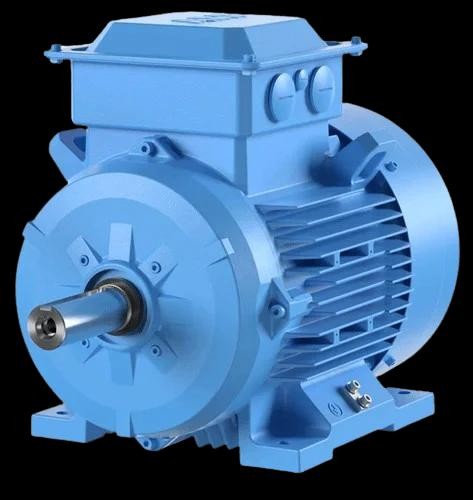

One of the most confusing topics you encounter when buying an electric motor is the two different standards that define the motor's frame size: IEC and NEMA. IEC is widespread in Europe and most of the world, while NEMA is common in North America. When fitting a motor to an imported machine, or replacing an old motor with a new one, you need to convert the frame numbers of these two standards into each other. A wrong conversion means the hole spacing of the motor arriving on site does not match, the shaft height does not fit, and the installation cannot be carried out. At DRG Motor, this article explains what IEC and NEMA frame sizes mean, how to read frame numbers, how to find equivalents, and what to watch out for in import/export motor replacements, together with tables.
What Is Frame Size?
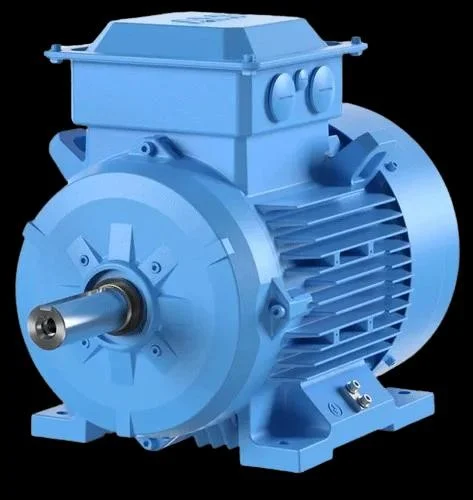
Frame size is a standard code that defines the physical dimensions of the motor. This code determines the motor's shaft height, foot hole spacing, shaft diameter and overall dimensions. Two motors of the same frame size can be interchanged even if they have different power, because their mounting dimensions are the same. This is how suppliers can fit motors from different brands to the same machine. You can find the IEC-side details of the frame size concept in our article on the IEC frame size standard.
How Does the IEC Standard Work?
In the IEC system, frame size expresses the distance from the center of the shaft to the base of the foot in millimeters. For example, a "132" frame means the shaft axis is 132 mm above the foot base. This logic is extremely practical: the frame number directly gives the shaft height. IEC frame numbers progress in standard steps such as 56, 63, 71, 80, 90, 100, 112, 132, 160, 180, 200, 225, 250, 280, 315.
In the IEC code, the letters following the number (S, M, L) indicate the foot hole spacing, that is, the length of the motor. S means short, M medium and L long body. For example, 132S and 132M have the same shaft height but different foot hole distances.
How Does the NEMA Standard Work?
In the NEMA system the frame number does not directly give millimeters; instead a coding logic is used. The first two digits of the NEMA frame number relate to one quarter of the shaft height (in inches). For example, in a 213T frame the figure "21" indicates the shaft height is 21/4 = 5.25 inches. The "T" at the end refers to the modern shaft dimensions standardized after the 1960s.
For this reason, reading a NEMA frame number is not as direct as IEC; it requires a conversion logic. This is the most fundamental difference between the two systems: IEC works with millimeters, NEMA with an inch-based coding.
IEC and NEMA Equivalence Table
The table below shows the most common IEC frame sizes together with their approximate NEMA equivalents and shaft heights. These values are approximate matches; they are not exactly identical, so detailed dimensions must always be verified before installation.
| IEC Frame | Shaft Height (mm) | Approx. NEMA Frame |
|---|---|---|
| 80 | 80 | 143T / 145T |
| 90 | 90 | 145T |
| 100 | 100 | 182T / 184T |
| 112 | 112 | 184T / 213T |
| 132 | 132 | 213T / 215T |
| 160 | 160 | 254T / 256T |
| 180 | 180 | 284T / 286T |
| 200 | 200 | 324T / 326T |
| 225 | 225 | 364T / 365T |
| 250 | 250 | 404T / 405T |
| 280 | 280 | 444T / 445T |
Why Isn't the Equivalence Exact?
Because IEC is millimeter-based and NEMA is inch-based, there is no perfect mathematical overlap between the two systems. For example, IEC 132 (132 mm) is approximately 5.2 inches; NEMA 213T gives a 5.25-inch shaft height. These small differences create a shift of a few millimeters in shaft height. More critical is that the foot hole spacing, shaft diameter and keyway dimensions are completely different in the two systems. For this reason, "equivalent" means "approximately the same power and size class," not "fits exactly."
Why Is Shaft Height So Important?
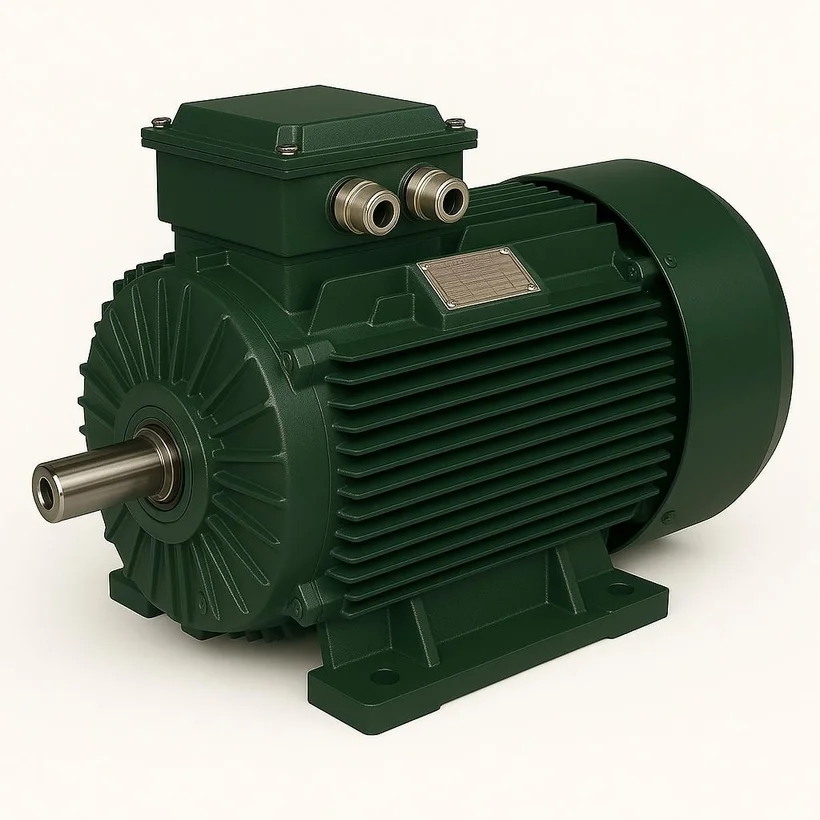
Shaft height is the fundamental dimension that determines the motor's alignment with the machine. If a pump or gearbox is designed for a specific shaft height, the shaft axes will not coincide when a motor of a different height is fitted. In this case the coupling is strained, vibration increases and bearing life is shortened. If shaft and coupling alignment cannot be done correctly, the motor fails in a short time. For this reason, shaft height is the first dimension to be verified in a frame conversion.
Shaft Diameter and Keyway Difference
In IEC and NEMA motors, shaft diameters can differ even in the same power class. IEC uses millimeter, NEMA inch-based shaft diameters. This difference directly affects coupling and pulley selection. When fitting a local motor to an imported machine, it must be checked whether the existing coupling fits the new motor's shaft. If necessary, an intermediate coupling or adapter bush can be used, but this brings additional alignment risk.
Mounting Type Compatibility: IEC and NEMA
Both standards have foot (IEC B3 / NEMA foot) and flange (IEC B5, B14 / NEMA C-face, D-flange) mounting types. However, the flange dimensions are completely different in the two systems; an IEC B5 flange does not fit a NEMA C-face flange. You can review the general relationship between mounting types in our article on motor mounting types. When converting, you must match not only the frame number but also the mounting type.
What to Watch When Fitting a Motor to an Imported Machine
A machine originating from North America is generally designed with a NEMA frame motor. When an IEC motor needs to be fitted to this machine, in addition to the frame equivalent, the hole spacing, shaft diameter and flange dimensions must also be checked. Often the foot holes must be re-drilled or an adapter plate used. The correct mounting type selection is of great importance at this stage.
Motor Selection for a Machine to Be Exported
A company manufacturing machines for the North American market requests a NEMA frame motor, usually running on a 60 Hz supply. Adapting an IEC-based motor to the NEMA market requires evaluation not only of the frame but also of voltage, frequency and certification. Frame conversion is only one part of this process.
The Relationship Between Power and Frame
A motor of the same power corresponds to different frame numbers in the IEC and NEMA systems. Moreover, even within the same system, the frame size can grow as the efficiency class rises. Because high-efficiency motors contain more copper and laminations, they may move up to a higher frame. For this reason, when converting power, not only the kW-HP conversion but also the frame growth must be considered.
kW and HP Conversion
IEC motors are labeled in kW (kilowatt), NEMA motors in HP (horsepower). 1 HP is approximately equal to 0.746 kW. For example, a 5.5 kW IEC motor is approximately 7.5 HP. However, because the standard power steps are different in the two systems, the result is rounded to the nearest standard value after conversion. This rounding can also affect the frame equivalent.
Speed and the Effect of Frequency
IEC motors are generally designed for a 50 Hz, NEMA motors for a 60 Hz supply. Frequency directly affects the motor's speed: at 60 Hz a motor with the same pole count rotates about 20% faster. If this difference is ignored in a frame conversion, the machine's operating speed turns out different from expected. Using a frequency inverter is a practical solution for managing the frequency-speed relationship.
Reading the Nameplate Information
When converting frames, the information on the motor nameplate is the most reliable source. The nameplate carries the frame number, power, speed, voltage and mounting type. When replacing an old motor, noting the existing motor's nameplate information in full is the most solid way to find the correct equivalent. If the frame number on the nameplate is unreadable, the system can be identified by measuring the shaft height and foot hole spacing.
Frame Selection in Terms of Bearings and Maintenance
As the frame size grows, the motor uses larger bearings and generally lasts longer. Correct frame selection determines not only mounting compatibility but also the mechanical strength of the motor. For the factors affecting bearing life, our article on extending bearing life is useful.
Frame Compatibility in Geared Applications
In a motor to be connected to a gearbox, the frame and flange dimension must match the gearbox input dimensions. IEC gearboxes expect an IEC input flange, NEMA gearboxes a NEMA C-face. When converting, the standard to which the gearbox side is designed is decisive. Our article on motor-gearbox compatibility explains this matching in detail.
Common Conversion Mistakes
The most common mistake is looking only at the power and neglecting the frame number. The second frequent mistake is assuming IEC and NEMA flanges can be fitted to each other. The third is overlooking the shaft diameter difference and forcing the old coupling onto the new motor. All of these mistakes can be prevented with detailed dimensional checks before installation. Correct conversion is done with real measurements, not on paper.
Steps to Follow When Finding an Equivalent
Following a sequential method is the safest way to find the correct equivalent. First, determine the old motor's frame number and shaft height. Then convert the power value to the target system with a kW-HP conversion. Next, match the mounting type (foot, flange) and flange dimensions. Finally, verify the shaft diameter and keyway dimension. When these four steps are completed in order, the risk of a non-fitting motor arriving on site is largely eliminated.
Frame Letter Codes: S, M, L and Their Meanings
The S, M and L letters following the IEC frame number are often overlooked but are decisive in conversion. At the same 160 shaft height there are 160M and 160L motors; both have the same shaft height but different foot hole spacing and overall lengths. This means it is important which letter the hole pattern on the machine base is designed for. A wrong letter choice causes the foot holes not to match even if the shaft height fits. For this reason, when writing a frame, the letter must be noted as well as the number.
Frame in Crane and Lifting Applications
In lifting and travel mechanisms the motor is generally connected to a gearbox and transmits high torque. In these applications frame selection is critical both for mechanical strength and gearbox input compatibility. In crane and lifting motor selection, the frame size is evaluated together with the radial and axial load the motor will carry. In these systems requiring a brake motor, the brake unit can also affect the frame size.
Frame in Water Pump Applications
In pump sets the motor shaft height must be on the same axis as the pump shaft. For this reason, when converting frames, the shaft height for which the pump is designed is decisive. Our article on electric motor selection for water pumps explains in detail how to ensure frame and mounting compatibility in pump applications.
Flange Type and Frame Must Be Evaluated Together
The frame number gives the motor's body size, but on a flange motor the flange type must also be determined separately. On the IEC side, B5 and B14 flanges have FF and FT hole types; on the NEMA side, C-face and D-flange use a separate coding. When converting frames, the flange dimensions must also match. Two motors with the same frame number cannot be interchanged if they are of different flange types. For this reason, in conversion the frame, shaft and flange trio must be verified together.
The Effect of Temperature and Operating Environment on Frame
A motor that delivers the same power under different ambient conditions is derated at a higher ambient temperature or high altitude; that is, less power can be drawn from the same frame. In this case, to provide the required power, it may be necessary to move up to a higher frame. When converting, not only the nominal values but also the temperature and altitude conditions of the operating environment must be considered. Otherwise, a motor that looks equivalent on paper may be insufficient in the field.
Protection Class and Frame Relationship
Although the frame size changes, the motor's protection class is selected according to the application. For a motor working in dusty and humid environments, the IP protection class is as important as the body size. During conversion, ensuring the old motor's protection class is also met by the new motor is critical, especially in outdoor and washdown applications.
Frame Selection in Two-Speed Motors
Motors running at two different speeds are sometimes produced in a larger frame than their single-speed equivalents, because a different winding layout can take up more space. When converting frames for two-speed electric motors, both the low and high-speed power values and their frame equivalents must be evaluated together.
Standard Frame in Terms of Maintenance and Backup
The biggest advantage of standard frame sizes is the possibility of fast backup in case of failure. When an IEC frame motor fails, it can be replaced in a short time with another motor of the same frame and mounting type. For this reason, building a plant's motor fleet from standard frames as much as possible eases spare parts management. Combined with regular maintenance steps, the use of standard frames supports production continuity.
DRG Motor for Correct Frame Conversion
Frame conversion between IEC and NEMA looks simple on paper but is full of millimeter-level detail in the field. At DRG Motor, within our AC asynchronous motor range we determine the IEC frame equivalent suitable for your imported machines or the existing motors you want to replace. Share your old motor's nameplate information and machine dimensions with us; let us find the solution compatible with the correct frame size, shaft diameter and mounting type together. For more technical information you can review our article on IEC frame size, and contact DRG Motor for your project.