 English
 Türkçe

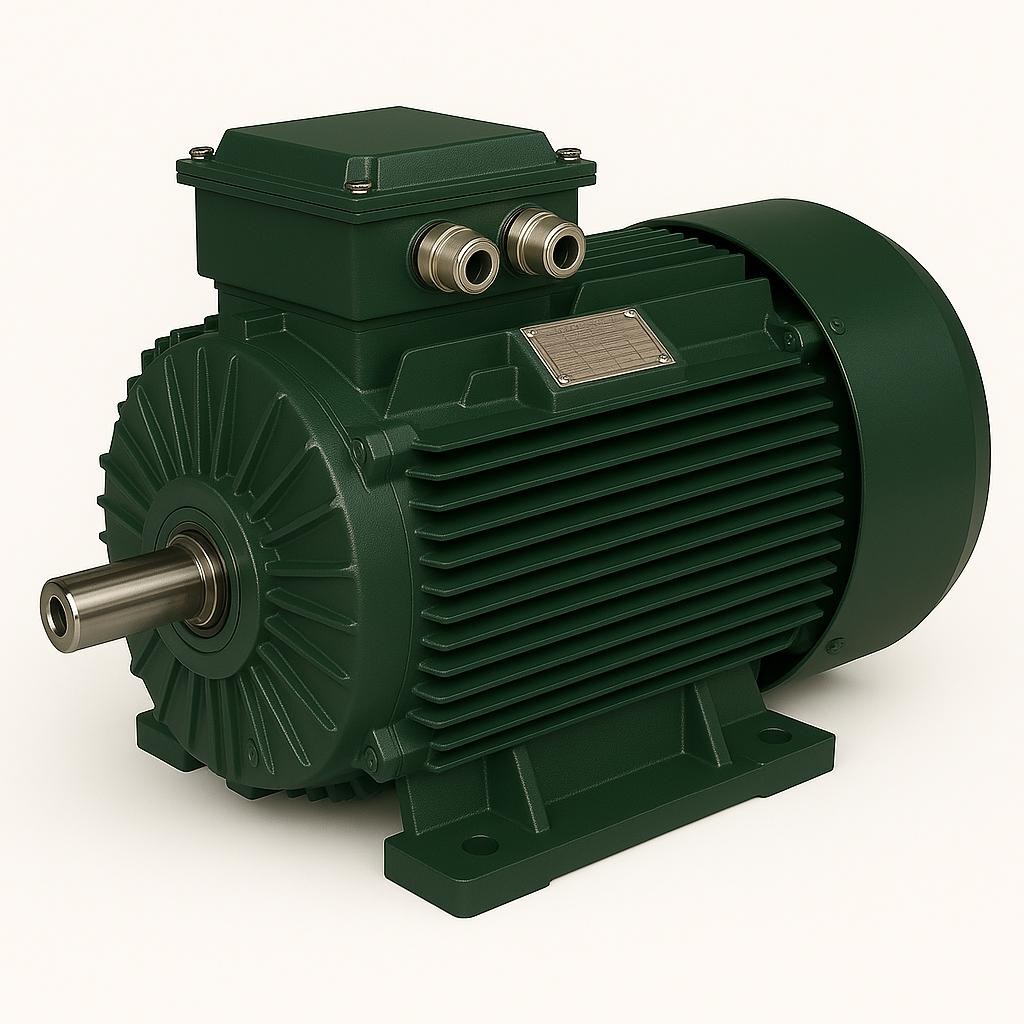

For workshops, small businesses, household appliances, and agricultural facilities where a three-phase grid is not available, single-phase induction motors are indispensable. However, these motors have a peculiar problem: a single alternating-current winding cannot produce a magnetic field that rotates on its own, and therefore the motor cannot start by itself. This is exactly where starting methods come into play. How a single-phase motor gets moving, and which method starts it, directly determines that motor's starting torque, operating characteristics, and suitable application. In this article we examine in detail why an auxiliary winding is needed in single-phase induction motors, the main starting types, and where each is used. To strengthen the basics, you can look at our what is an electric motor article.
The Fundamental Problem of the Single-Phase Motor
When alternating current is applied to a single winding, the resulting magnetic field does not rotate; it merely grows and shrinks in place. This field is called a "pulsating field." Because the pulsating field produces equal effects in both the forward and backward directions in the rotor, no net direction of rotation forms; the rotor stays where it is. What is interesting is this: if the rotor is pushed in one direction somehow, it continues to rotate in that direction. So the problem is not that the motor cannot rotate, but that it cannot choose a direction on its own. All starting methods aim to create this initial direction and starting torque.
Why Is a Rotating Field Needed?
In three-phase motors, rotation is produced by the rotating magnetic field that the phase difference between the three windings naturally creates. This is one of the reasons three-phase motors are so widespread in industry; we detailed the topic in our three-phase motor in industry article. In a single-phase motor, since there is only one winding, no such natural phase difference exists. The solution is to add a second winding and create an artificial phase difference between them. This is exactly the task of the auxiliary winding.
The Role of the Auxiliary Winding
The auxiliary winding is placed at a 90-degree spatial offset relative to the main winding. When the current passing through this winding flows with a certain phase difference relative to the current in the main winding, the magnetic field that the two windings create together resembles a rotating rather than a pulsating field. This rotating-like field pushes the rotor in one direction and the motor starts. Depending on the method used to create the phase difference, single-phase motors take different names: split-phase, capacitor-start, capacitor-run, and permanent-capacitor.
Ways to Create the Phase Difference
There are two basic ways to create a phase difference between the two windings. The first is to make the auxiliary winding thinner and more resistive than the main winding; this creates a natural phase difference between the windings. The second, and far more effective, is to connect a capacitor in series with the auxiliary winding. The capacitor shifts the current ahead relative to the voltage, creating a much more pronounced phase difference and thus a much stronger starting torque. We examined the effect of the capacitor on motor behavior in detail in our single-phase motor and capacitor article.
Split-Phase Starting
This is the simplest method. The auxiliary winding is made with higher resistance than the main winding, so a small phase difference forms between the two winding currents. This difference produces just enough starting torque to set the motor in motion. When the motor reaches about three-quarters of its nominal speed, a centrifugal switch disconnects the auxiliary winding and the motor continues to run on the main winding alone. This method is suitable for applications requiring low to medium starting torque; the starting torque is limited.
Capacitor-Start Starting
In this method, a capacitor is added in series with the auxiliary winding. Since the capacitor markedly increases the phase difference, the starting torque is much higher than in the split-phase method. Once the motor reaches a certain speed after starting, the centrifugal switch disconnects both the capacitor and the auxiliary winding. Thus only the main winding remains active during operation. It is ideal for applications requiring high starting torque such as compressors, pumps, and loaded conveyors.
Capacitor-Run Starting
In this design the capacitor stays in the circuit not only during starting but throughout operation. Since the auxiliary winding and capacitor are continuously active, the motor runs more smoothly, more quietly, and with a higher power factor. The starting torque is slightly lower than in the capacitor-start design; however, the performance and efficiency during operation are better. It is preferred in applications where continuous and balanced operation is desired.
Permanent-Capacitor Starting
In permanent-capacitor motors, a single capacitor stays in the circuit during both starting and operation, and there is no centrifugal switch. This makes the motor simpler, more durable, and easier to maintain, because there is no switch to wear out. Since the starting torque is relatively low, it is suitable for applications that start unloaded or lightly loaded, such as fans and ventilation. Their simple structure and long service life make these motors a preferred choice in many everyday applications.
Two-Capacitor Solutions
Some designs use two capacitors to offer both high starting torque and good running performance together. At startup, a large-value start capacitor engages to provide strong torque; when the motor speeds up, the centrifugal switch disconnects this capacitor and a smaller-value run capacitor remains in the circuit. This achieves both a strong start and efficient operation. This approach addresses a wide range of applications.
Comparison of Starting Methods
The table below summarizes the main starting methods in terms of starting torque, structural complexity, and typical use. The right method should always be chosen according to the application's load and starting needs.
| Method | Starting Torque | Centrifugal Switch | Typical Use |
|---|---|---|---|
| Split-phase | Low-medium | Yes | Lightly loaded machines |
| Capacitor-start | High | Yes | Compressors, pumps |
| Capacitor-run | Medium | No | Continuous, quiet operation |
| Permanent-capacitor | Low | No | Fans, ventilation |
| Two-capacitor | High | Yes | Wide application range |
The Role of the Centrifugal Switch
Many single-phase motors have a centrifugal switch that disconnects the auxiliary winding or the start capacitor after starting. This switch opens by centrifugal force when the motor reaches a certain speed. The switch's role is important: keeping the auxiliary winding energized continuously can lead to both unnecessary heating and burning of the winding. A fault in the switch shows itself with symptoms such as the motor failing to start or the auxiliary winding burning out.
Why Is the Starting Torque Different?
The most pronounced difference between methods is starting torque. Designs that use a capacitor produce higher starting torque because they create a more pronounced phase difference. Designs that rely only on a resistive auxiliary winding offer lower torque. How much load the application must work against at startup directly determines the method choice. A compressor that starts loaded requires strong starting torque, while a fan that starts unloaded is content with low torque.
Which Method for Which Application?
In practice, method selection can be summarized as follows: the split-phase method for simple machines that start lightly loaded; the capacitor-start method for compressors and pumps requiring high starting torque; the capacitor-run method where quiet and continuous operation is desired; and the permanent-capacitor method for fans where a simple structure and low maintenance are wanted. Two-capacitor solutions are for cases where both starting and running performance matter together.
Single-Phase vs. Three-Phase Motor Comparison
Although single-phase motors are practical, the natural rotating field of three-phase motors provides higher efficiency and smoother torque. For this reason, as power increases and continuous industrial use is involved, three-phase motors are preferred. We examined slip, the fundamental operating phenomenon of induction motors, in our induction motor slip article, and rotor types in our squirrel cage vs wound rotor motor article.
Pole Count and Speed
In single-phase motors too, speed is determined by pole count and mains frequency. At the same frequency, a motor with more poles rotates at a lower speed. Selecting the speed required by the application with the right pole count is important; we covered this relationship in our pole count and speed article.
The Importance of Capacitor Selection
In capacitor designs, choosing the correct capacitor value is critically important. A capacitor value that is too low leads to weak starting torque, while one that is too high causes excessive current and strain on the winding. Furthermore, start capacitors and run capacitors have different structures; start capacitors are made for short-duration high current, while run capacitors are made for continuous operation. Using the wrong type of capacitor causes both performance loss and early failure.
Frequently Encountered Faults
The most common problems in single-phase motors are capacitor failure, centrifugal switch problems, and burning of the auxiliary winding. A motor that fails to start and only hums usually indicates a problem caused by the capacitor or the auxiliary winding. An appropriate protection plan is essential to protect the motor in case of overload; our overload protection article is a useful guide on this subject.
Protection and Safety
In single-phase motors, protection against overheating, overload, and mechanical faults is also important. Regular maintenance, checks of the capacitor and switch, and winding insulation measurement extend the motor's service life. You can find the general maintenance approach in our electric motor maintenance steps article, and ways to extend bearing life in our extending bearing life article.
Vibration and Noise
Because the torque of single-phase motors is, by nature, less smooth than that of three-phase motors, they may show a tendency toward slight vibration. Proper installation, a balanced rotor, and the right capacitor choice reduce this tendency. We covered practical ways to keep vibration and noise under control in our reducing noise and vibration article. Proper alignment of the motor's connection to the load also reduces vibration; we examined this in our shaft-coupling alignment article.
Winding Structure and Internal Connections
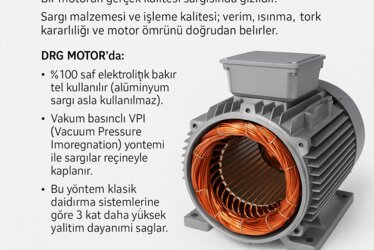
When we look inside a single-phase induction motor, we see two separate winding groups in the stator: the main winding and the auxiliary winding. The main winding, which produces the actual magnetic field during operation, has thicker wire and low resistance. The auxiliary winding has thinner wire, higher resistance, and is placed at a 90-degree spatial offset relative to the main winding. The correct connection of these two windings also determines the motor's direction of rotation. When the leads of the auxiliary winding are swapped, the motor turns in the opposite direction; this feature offers a practical advantage in applications where the direction of rotation needs to be changed. Sound insulation between the windings is critically important for the motor's safe operation; when insulation weakens, a short circuit between windings and subsequent burning become inevitable.
What Happens During Operation?
When the motor completes its start and approaches nominal speed, an interesting situation arises: the rotating rotor itself now helps the single-phase pulsating field resemble an effective rotating field. For this reason, in split-phase and capacitor-start designs, the motor can keep running even after the auxiliary winding is disconnected following startup. During operation, the motor's behavior depends largely on the main winding and rotor interaction. In permanent-capacitor and capacitor-run designs, since the auxiliary winding stays continuously in the circuit, torque is smoother and vibration is lower throughout operation. This explains why some applications prefer designs that keep the capacitor permanently engaged.
Efficiency and Power Factor
In single-phase motors, efficiency and power factor vary according to the chosen starting method. Capacitor-run and permanent-capacitor designs generally offer a better power factor because the capacitor stays in the circuit during operation. Designs that rely only on a resistive auxiliary winding may lag somewhat in efficiency, since they run on the main winding alone during operation. In continuously running applications where energy cost matters, designs that keep the capacitor engaged can be more economical in the long run. The advantage of three-phase motors in efficiency should not be overlooked either; in high-power, continuously running systems, three-phase is almost always more efficient.
Commissioning and First Start
When commissioning a single-phase motor for the first time, paying attention to a few points prevents problems down the road. First, make sure the supply voltage matches the value written on the motor nameplate; the wrong voltage leads to both weak starting and winding strain. In capacitor designs, the capacitor should be checked for correct value and integrity. The motor's direction of rotation is determined by connecting the auxiliary winding leads correctly during wiring. On the first start, observe that the motor starts without straining, without unnecessary humming, and without overheating. If there is hesitation, noise, or heating at startup, the problem most likely lies in the capacitor, auxiliary winding, or centrifugal switch. These checks provide a sound start for the motor's long service life.
A Practical Summary for Choosing the Right Method
When choosing a single-phase motor, the question to answer is simple: will the motor start under load or unloaded? A loaded start requires strong starting torque and favors capacitor-start or two-capacitor solutions. An unloaded or lightly loaded start is easily met with permanent-capacitor or capacitor-run designs. The right method ensures the motor runs both long and efficiently.
Single-Phase Solutions with DRG Motor
At DRG Motor, although our primary expertise is three-phase IE3, IE4, and IE5 efficiency-class AC induction motors, we also help you plan the right starting method and the right power-speed selection for single-phase applications. By evaluating your application's starting torque needs, operating time, and environmental conditions together, we recommend the most suitable motor for you. Whether single-phase or three-phase, to choose the right motor the first time, you can get in touch with the DRG Motor team. Explore more on our homepage.