 English
 Türkçe

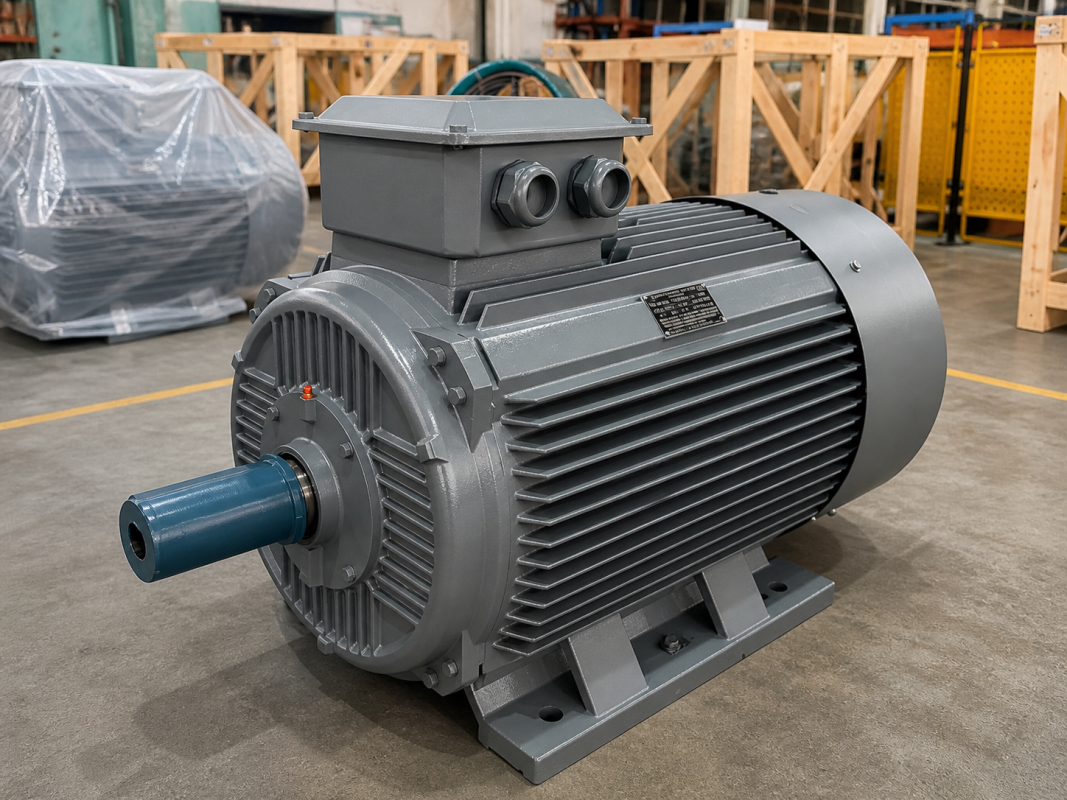

The small metal plate on an electric motor is, in effect, that motor's identity card. Among the codes printed on this nameplate, perhaps the most asked about and the most critical for energy cost is the IE efficiency class. The IE code shows directly how efficient the motor is and therefore how much it will cost your business each year. Yet many users do not know where to find this code on the nameplate or how to interpret it. In this article we explain step by step how to read the IE efficiency class from a motor nameplate, the other important nameplate information, and what the IE classes mean. For a foundational view, our article on the importance of electric motor nameplate information is a good complement.
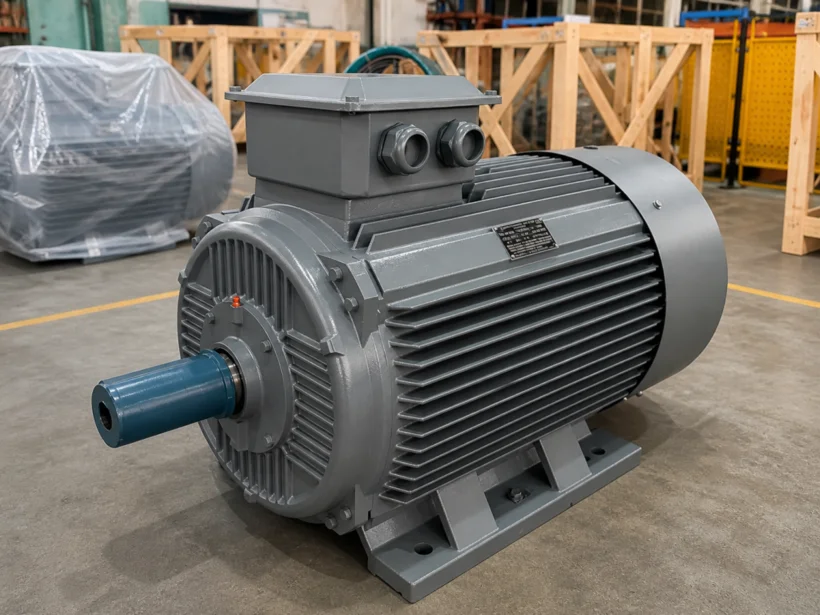
What Is a Motor Nameplate?
A motor nameplate is the metal or plastic plate on which the manufacturer presents the motor's technical specifications in a standard format. It is usually riveted or glued to the motor frame. This plate contains the power, voltage, current, speed, efficiency class, protection degree and much more. Nameplate information is not merely a reference but an essential guide for selecting, connecting and maintaining the motor correctly. Knowing how to read the nameplate is the first step to choosing the right motor.
What Is the IE Code and What Does It Mean?
IE is short for "International Efficiency". The IE code classifies a motor's energy-efficiency level on an international scale. As you move from IE1 to IE5, the motor's efficiency rises; that is, it does the same work using less electricity. A motor of class IE3 or IE4 delivers a noticeable saving on the annual energy bill compared with an old IE1-class motor. We detailed why high efficiency matters in our article on high-efficiency electric motors.
Where Is the IE Code Written on the Nameplate?
The IE code is usually written clearly on the nameplate as "IE2", "IE3", "IE4" and so on. On some nameplates it appears together with the efficiency value (for example "IE3 - 91.4%"). The code is usually near the power (kW) and efficiency percentage. On older motors, instead of an IE code there may be older classifications such as "EFF1", "EFF2", or no efficiency class at all; in that case the motor's efficiency is estimated from the percentage value or the manufacturing date. On new motors, the IE code is legally required on the nameplate.
IE Efficiency Class Table
The table below shows the IE efficiency classes, their names and brief explanations according to the IEC standard. It lets you quickly understand what the code on your nameplate means.
| IE Code | Class Name (Efficiency Level) | Explanation |
|---|---|---|
| IE1 | Standard Efficiency | Old generation, lowest efficiency; largely banned in new sales |
| IE2 | High Efficiency | Mid level; limited use with an inverter in many regions |
| IE3 | Premium Efficiency | Today's common legal minimum standard |
| IE4 | Super Premium Efficiency | High efficiency; preferred in energy-intensive applications |
| IE5 | Ultra Premium Efficiency | Highest efficiency; lowest loss, new-generation designs |
The IEC 60034-30-1 Standard
The IE efficiency classes are defined by the international standard IEC 60034-30-1. This standard specifies the conditions under which motors are tested and which efficiency value corresponds to which IE class. The classification is based on efficiency threshold values that vary with the motor's power, pole count and frequency. For example, the efficiency a 7.5 kW 4-pole motor must reach to be IE3 differs from that of a 75 kW motor; the thresholds are higher for large motors because large motors are inherently more efficient.
The Power (kW) Information on the Nameplate
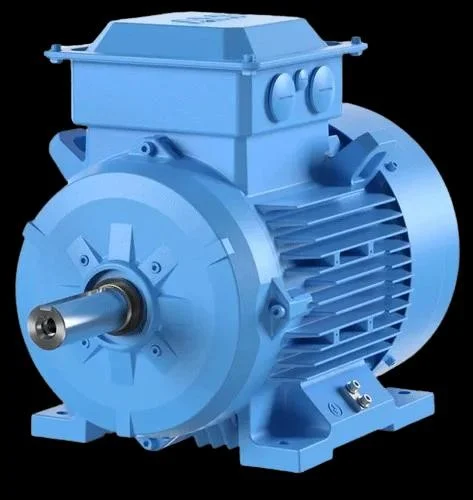
One of the most prominent pieces of information on the nameplate is the motor's rated power (kW or HP). This is the mechanical output power the motor can deliver to the shaft; it is not the electrical power it draws from the supply. The power value is the fundamental parameter that sets the threshold for the IE efficiency class. Choosing a motor of the correct power is critical for both efficiency and lifespan. To choose across a wide kW range, our article on high and low kW motors is a helpful guide.
The Speed (rpm) Information
The speed value on the nameplate is the motor's rotational speed at full load. This value also indirectly indicates the pole count: around 2900 means 2 poles, around 1450 means 4 poles, around 960 means 6 poles. The nameplate speed is slightly below the synchronous speed; the difference is the slip. We covered the pole count and speed relationship in our article on pole count and speed, and slip in our article on slip in an induction motor.
Voltage and Connection (V, Δ/Y)
Voltage values on the nameplate are usually given as two values such as "230/400V" together with delta-star (Δ/Y) symbols. This shows at which voltage and with which connection the motor should be operated. An incorrect connection can burn out the motor. On a 400V three-phase supply, most standard motors are connected in star (Y). The connection diagram is also found inside the terminal box cover.
The Current (A) Information
The rated current on the nameplate is the current the motor draws when running at full load. This value is the basis for selecting the protection relay and cable cross-section. Separate current values are usually given for each voltage/connection. A drawn current well above the nameplate value indicates that the motor is overloaded or that a fault is developing.
The Protection Degree (IP) Information
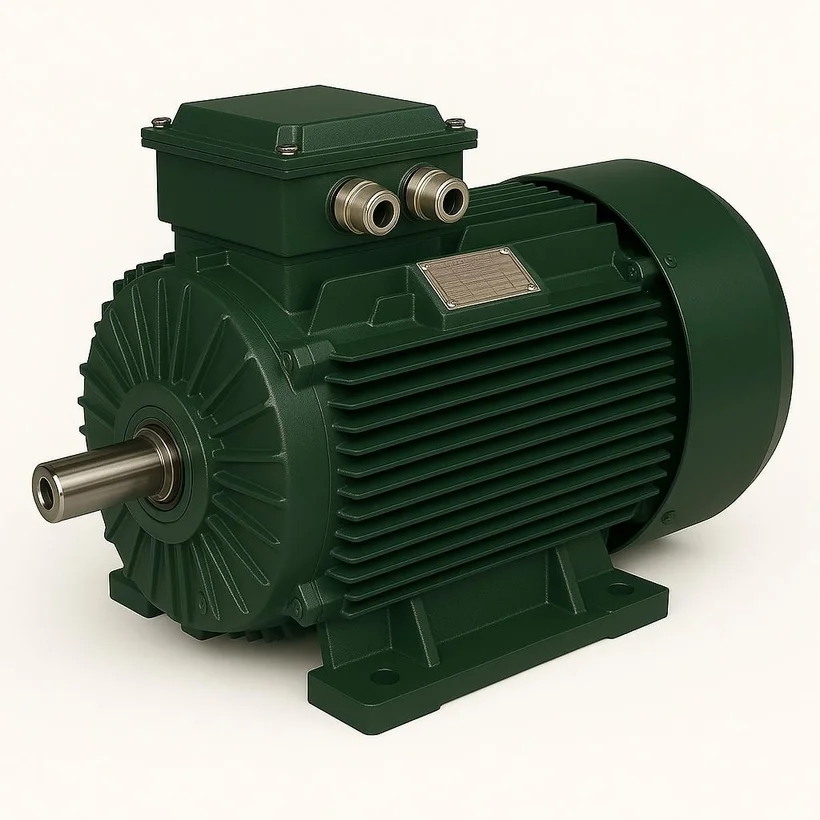
The IP code (for example IP55) shows the motor's degree of protection against dust and water. The first digit indicates protection against solid objects/dust, the second against water. IP55 means dust-protected and resistant to water jets from any direction, which is a common standard for industrial environments. In dusty, humid or outdoor applications, choosing the correct IP degree is critical for motor life.
Insulation Class and Temperature
The insulation class (usually the letter F or H) shows the maximum temperature the winding insulation can withstand. Class F withstands up to 155°C, class H up to 180°C. A higher insulation class lets the motor operate safely in hotter environments or at higher loads. The nameplate also states the ambient temperature (usually 40°C) and the duty type (such as S1 continuous operation).
Power Factor (cosφ)
cosφ (power factor) shows how much of the apparent power the motor draws is turned into useful work. At full load a good motor has a cosφ around 0.80-0.88. A low power factor means unnecessary reactive power is drawn from the supply, which can incur extra cost under some tariffs. Selecting the motor to suit its load keeps the power factor in the ideal range.
Brand, Model and Serial Number
The nameplate also carries the manufacturer's name, the motor model (type code) and the serial number. This information is needed for spare-parts supply, warranty processes and technical support. The type code usually also hints at the frame size, pole count and mounting type. For mounting type selection, see our article on mounting type selection.
The Reflection of Efficiency Measurement in the Nameplate Value
The IE class and efficiency percentage on the nameplate are based on values the manufacturer measured under standard test conditions. These values apply when the motor runs at full load and rated voltage. If, in the real field, the motor runs at partial load, low voltage or with unbalanced phases, the actual efficiency may deviate somewhat from the nameplate value. So it is best to think of the nameplate efficiency as a ceiling value and to run the motor close to that ceiling by sizing it to suit its load. An oversized motor, even with a high IE class, will not deliver the expected efficiency at low load; this shows that correct sizing is as important as the nameplate class.
Reading the IE Class Step by Step
To read the IE class from the nameplate, follow these steps: First find the code beginning with "IE" on the nameplate (IE2, IE3, IE4...). If there is an efficiency percentage next to it, note it. If it is an older motor, look for the "EFF" code or just the efficiency percentage. Evaluate the IE code together with the motor's power and speed, because the same IE class corresponds to different percentages at different powers. Finally, multiply the IE class by your annual running hours to calculate the energy-saving potential.
The Legal Dimension of Moving Between IE Classes
In many countries and regions, it has become legally mandatory for motors in a certain power range to meet a minimum IE class. These regulations are tightened gradually over time to increase energy efficiency and reduce the carbon footprint. Where IE1 motors were once sold freely, the minimum was later raised to IE2, then to IE3; in some power ranges IE4 is now targeted. So when buying a new motor, you must consider not only the immediate price but also the efficiency regulations in force and the motor's future compliance. The presence of the correct IE code on the nameplate is also proof that the motor complies with these regulations.
The Relationship Between Efficiency Percentage and IE Class
It is common to see both an efficiency percentage (for example 91.4%) and an IE code (for example IE3) on the nameplate. The two complement each other: the IE code shows the class, while the percentage shows the actual value within that class. The efficiency percentages of two motors in the same IE3 class can differ according to power and pole count. So when comparing two motors, looking at the actual efficiency percentage at the same power and speed, rather than just the IE code, gives a more accurate comparison. We covered the finer points of high-efficiency motor selection in detail in our article on high-efficiency electric motors.
How the IE Class Affects Energy Cost
The cost of the electricity a motor consumes over its lifetime far exceeds its purchase price. So even a difference of a few percentage points in efficiency turns into serious money over the years for a continuously running motor. For example, choosing IE4 instead of a large continuously running IE3 motor can repay the extra investment in a few years. Energy savings with a frequency inverter increase this saving even further.
Duty Type (S1-S9) and Operating Regime
Another piece of information often overlooked on the nameplate but very important is the duty type. S1 indicates the motor runs continuously at a constant load, and most standard industrial motors are in this class. S2 means short-time and S3 means intermittent periodic operation; in applications that start and stop frequently or run only at certain intervals, the duty type must be chosen correctly. A wrong duty-type choice leads either to an unnecessarily large and expensive motor or to a motor that overheats and fails early. So in systems carrying intermittent loads such as cranes, lifts or presses, the duty type on the nameplate must always be checked.
Frequency (Hz) and Grid Compatibility
The frequency value on the nameplate (usually 50 Hz or 50/60 Hz) shows the supply frequency for which the motor was designed. This value is the fundamental parameter that sets the synchronous speed and therefore the motor's actual speed. Running a 50 Hz motor on a 60 Hz supply, or vice versa, changes the speed, torque and efficiency values; so frequency compatibility must always be checked. In applications using a frequency inverter, the motor can be run over a wide frequency range, but even then the nameplate values form the reference point of the design.
Weight and Bearing Information
Some nameplates also state the motor's weight and the bearing types used. Weight information is needed for transport, lifting and mounting planning. Bearing codes make it easier to obtain the correct spare part during maintenance; bearing replacement is one of the most frequent maintenance tasks, especially on motors that have run for a long time. Thanks to the bearing information on the nameplate, it is possible to quickly find a bearing of the correct type and size. This small detail offers a practical advantage that reduces unplanned stoppages.
The Importance of Keeping Nameplate Information
Over time, the motor nameplate may become unreadable due to dirt, oil or corrosion. So it is strongly recommended to photograph the nameplate information during commissioning and record it in a maintenance log. When the nameplate becomes unreadable, these records become invaluable in spare-parts supply, warranty and technical-support processes. A well-kept motor inventory directly increases the plant's maintenance efficiency and prevents lost time when a fault occurs.
QR Codes and Digital Nameplates
On new-generation motors, in addition to the classic printed nameplate, there may be a QR code or a digital nameplate. When this code is scanned, it becomes possible to access instantly all of the motor's technical documents, efficiency curves, connection diagrams and spare-parts lists. This approach greatly simplifies maintenance and inventory management, especially in large plants with many motors. A digital nameplate also reduces the risk of the physical plate wearing out; the information is stored permanently in online records and can be updated as needed.
Common Mistakes When Reading the Nameplate
One of the most common mistakes is confusing the nameplate power (the mechanical power delivered to the shaft) with the electrical power the motor draws. The second is assuming the speed value is the synchronous speed. The third is comparing the IE class by percentage alone; since the IE class is defined by power, the percentages of motors of different powers cannot be directly compared. To avoid these mistakes, our article on three-phase motor in industry is helpful.
Choosing the Right Efficiency Class With DRG Motor
When read correctly, the motor nameplate is an invaluable source of information for your plant's energy efficiency and safety. Knowing how to read the IE efficiency class from the nameplate is the first step to bringing your energy costs under control. At DRG Motor we offer motors in IE3, IE4 and higher efficiency classes suited to your application, and we provide technical support in choosing the right efficiency class and power. To find the right motor to lower your plant's energy bill, you can review the DRG Motor products and contact our expert team. For more technical content, see our industrial electric motors resource or visit our homepage.