 English
 Türkçe

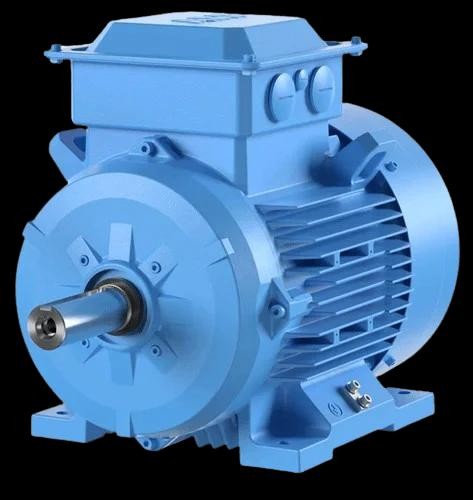

A frequency inverter can change the speed of an induction motor, but how it does so depends on the control method you choose. There are two fundamental approaches: scalar V/f control and vector control. Both drive the motor, but the way they produce torque, their low-speed behavior and their precision differ greatly. Choosing the wrong method leads either to an unnecessarily expensive solution or to a drive that does not meet the application's demand. In this article we explain the difference between V/f and vector control, where each is sufficient, and which one we recommend for which application in the field at DRG Motor.
How Does a Frequency Inverter Change Speed?
The synchronous speed of an induction motor is directly proportional to the supply frequency. Lower the frequency and the motor slows down; raise it and the motor speeds up. The inverter does exactly this: it converts the grid frequency to the value you want. For the energy dimension of this logic, the article on energy saving with a frequency inverter provides the foundation.
Frequency Alone Is Not Enough
If you keep the voltage constant while lowering the frequency, the motor's magnetic flux rises excessively and the winding saturates. For this reason the voltage must be adjusted together with the frequency. This is where the name V/f control comes from: it keeps the voltage/frequency ratio constant.
What Is Scalar V/f Control?
V/f control changes the voltage and frequency together at a fixed ratio. It does not take the motor's internal state (flux, rotor position) into account; it only applies voltage and frequency from outside. It is simple, inexpensive and stable. For many applications it is more than sufficient.
The Strengths of V/f Control
V/f control is easy to commission, requires few parameters and allows driving more than one motor with a single inverter at the same time. It works perfectly with variable-torque loads such as pumps and fans. In cost-focused projects this is most often the first choice. Because it does not require auto-tune, it can be quickly run with different motors, and replacing a spare inverter is simple as well. The maintenance team dealing with few parameters provides operational convenience in the long run. This simplicity is the most important reason V/f is still the most widely used method.
The Limits of V/f Control
V/f control struggles to produce torque at low speeds because the voltage drop across the stator resistance becomes relatively large. It also responds slowly to sudden load changes and cannot perform precise speed regulation. When the load increases, the speed drops somewhat.
Torque Boost
To improve low-speed torque, V/f control offers a "torque boost": at low frequencies it raises the voltage slightly to compensate for the stator resistance loss. This increases the starting torque but, if set excessively, heats the motor at no load. Correct setting matters here as well.
What Is Vector Control?
Vector control (field-oriented control) mathematically separates the motor's current into magnetic-flux-producing and torque-producing components and manages them independently. This way torque can be controlled instantly and precisely, as in a DC motor. This means high and stable torque even at low speed. While V/f control applies only voltage and frequency to the motor, vector control continuously calculates what is happening inside the motor and directs the current accordingly. This is the fundamental difference: one drives blindly, the other drives knowing what it is doing.
Separating the Flux and Torque Components
At the heart of vector control lies the separation of the motor current into two perpendicular components: one establishes the magnetic field, the other produces torque. When these two can be adjusted independently, the flux can be held constant and the torque raised instantly even if the load's demand changes. The result is a drive that can hold its speed even under sudden load shocks. In scalar control there is no such separation; because voltage and frequency change together, the torque response is always delayed.
Sensorless (Open Loop) Vector Control
In sensorless vector control the inverter calculates the rotor position from the motor model; it does not use an additional encoder. It provides much better low-speed torque and speed accuracy than V/f, but is limited in the region near zero speed. For many industrial applications it is the ideal balance.
Closed Loop Vector Control
In closed loop vector control an encoder is added to the motor and the inverter measures the rotor position directly. Full torque at zero speed, the highest speed accuracy and the fastest response are obtained with this method. It is used in demanding applications such as elevators, cranes and machine tools.
Comparison of V/f and Vector Control
| Feature | Scalar V/f | Sensorless Vector | Closed Loop Vector |
|---|---|---|---|
| Torque precision | Low | High | Very high |
| Low-speed torque | Weak | Good | Full torque at zero speed |
| Speed accuracy | Medium | Good | Very high |
| Dynamic response | Slow | Fast | Very fast |
| Encoder requirement | None | None | Required |
| Ease of commissioning | Very easy | Medium | More complex |
| Typical application | Pump, fan | Conveyor, extruder | Crane, elevator, machine tool |
The table is a decision tool; you can read the rows according to the application's torque and precision demand and choose the most suitable method. As you go from left to right capability increases, but cost and commissioning difficulty rise as well. The right decision is to choose the leftmost column the application truly needs; buying more capability than required unnecessarily increases both the budget and the maintenance burden.
Same Motor, Different Control
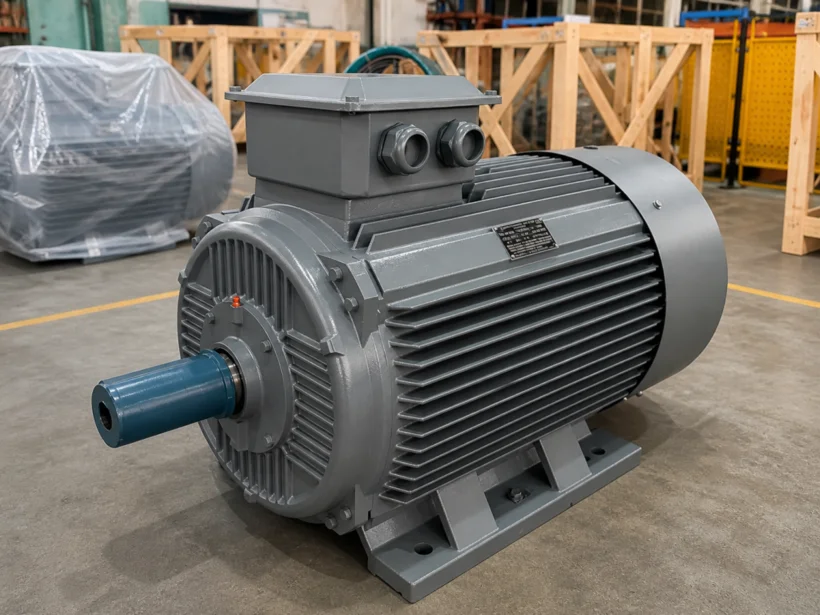
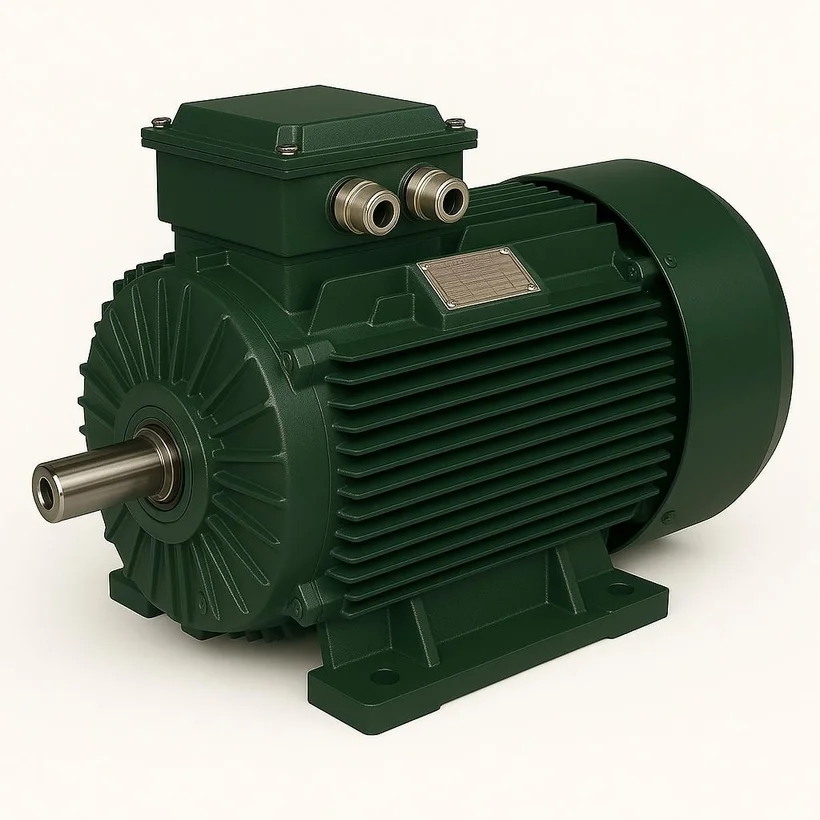
An important point is that the same standard induction motor can usually be driven by all three methods. That is, what determines the control method is not the motor but the inverter setting and the application's demand. This makes selection flexible: with the same motor, V/f can run in one plant and sensorless vector on another line. For closed loop, it is enough to add only an encoder to the motor. This flexibility also explains why standard motors are so widely used.
When Is V/f Sufficient?
If the load is variable-torque (pump, fan), if precise speed regulation is not needed and high torque at low speed is not expected, V/f is more than sufficient. For such loads, the motor selection by load type approach also points toward V/f.
Why V/f for Pumps and Fans?
In centrifugal pumps and fans, torque increases with the square of speed; that is, at low speed only low torque is needed anyway. These loads do not need the high low-speed torque that vector control provides. V/f is both sufficient and economical, and it also provides most of the energy saving.
When Is Vector Needed?
Constant-torque loads, applications demanding high torque at low speed and systems requiring precise speed/torque control call for vector control. Conveyors, extruders and mixers fall into this class. To resolve the load profile correctly, the motor selection by load type analysis is essential.
Crane and Lifting Applications
In a crane the load must be held suspended at zero speed and must not drop at start. This means full torque at zero speed, and only closed loop vector control safely provides it. Using V/f here is unacceptable from a safety standpoint. Even the smallest delay between the moment the brake opens and the motor producing full torque causes the load to slip back. Closed loop vector, with the position information it receives from the encoder, manages this transition flawlessly and takes over the load without dropping it a single millimeter. In lifting applications, method selection is therefore not a preference but a necessity.
Machine Tools and Precision Positioning
In spindle and axis drives, speed accuracy and dynamic response are critical. When the cutting force changes, the speed must remain constant. These applications generally demand closed loop vector or servo-level control.
Extruders and Continuous Processes
In plastic extruders the smoothness of material flow directly affects product quality. The speed must remain constant even if the load fluctuates; that is why sensorless or closed loop vector is preferred. The speed drop of V/f under load is not acceptable here. As the screw pressure changes the torque on the motor changes too; vector control compensates for this change instantly and keeps the line speed constant. Since even a fluctuation of a few rpm can make a difference in film thickness or profile cross-section, speed stability is a quality parameter in continuous processes.
Textile and Winding Applications
In yarn winding, film winding and similar applications, as the bobbin diameter increases the torque must be continuously adjusted to keep the circumferential speed constant. This is a scenario where torque precision rather than speed comes to the fore, and it is the natural domain of vector control. V/f cannot maintain the winding tension with the required precision; in these applications stable torque production directly determines the usability of the product.
Driving Multiple Motors with a Single Inverter
If multiple parallel motors are to be driven from the same inverter, vector control is not suitable because the model is built for a single motor. In this scenario V/f is the only option. This is a common choice in multi-motor fan groups. When several motors are fed at the same frequency, each slips according to its own load and the system balances itself; the single-motor model vector control needs loses its meaning in this case. For this reason, in pump or fan groups fed from a common busbar, V/f is the correct choice both technically and economically.
Entering Motor Data Correctly
Especially in vector control, the inverter must know the motor parameters (resistance, inductance) correctly. For this an "auto-tune" procedure is performed: the inverter measures the motor and derives its model. An incorrect or skipped auto-tune eliminates the advantage of vector control.
Noise and Switching Frequency
The inverter's switching frequency affects the sound the motor emits. At a low switching frequency the motor may emit an audible hum; raising it reduces the noise but increases the heat loss in the inverter. This setting is independent of the control method, but in both V/f and vector applications it must be balanced for comfort and efficiency. In environments where noise matters, the switching frequency should be chosen deliberately.
Cost and Complexity Balance
Vector control is more capable but more expensive and harder to commission. Closed loop requires an additional encoder and wiring. If the application does not truly demand it, unnecessary complexity increases both the cost and the probability of failure. The correct approach is to choose one step above the need, not more.
Is There a Difference in Energy Saving?
Both V/f and vector provide energy saving by delivering variable speed instead of fixed speed. In pumps and fans most of the saving already comes from reducing the speed, so V/f is sufficient in this respect. For the details of the topic you can look at the article on energy saving with a frequency inverter.
Starting Behavior and the Inverter
Because the inverter raises the frequency from zero with a ramp, the inrush current is much lower than with direct-on-line starting. Evaluating this topic together with the article on motor starting and inrush current clarifies which starting method is appropriate.
The Cooling Problem at Low Speed
If the motor is to run at low speed with high torque for a long time, the fan on the shaft cannot provide enough cooling. In applications that produce high torque at low speed with vector control, an external (forced) cooling fan may be needed. Cooling must also be taken into account when choosing the method.
The Effect of the Load Inertia Ratio
The inertia ratio between the motor and the load determines how hard the control method will be pushed. If the load inertia is very large compared to the motor, acceleration and deceleration take a long time and dynamic response becomes unimportant; here V/f does the job. In applications where inertia is low and rapid direction/speed change is required, the fast response of vector control becomes decisive. For this reason, before choosing the method, not only the load type but also the inertia ratio should be evaluated.
Frequency Range and Field Weakening
The inverter can drive the motor above the rated frequency as well, but in this region the voltage can no longer rise and the magnetic flux weakens. This is called the field-weakening region; here the motor runs at constant power but with falling torque. In applications that will run at high speed this behavior applies to both V/f and vector, and whether the motor can produce sufficient torque at that speed must be checked from the outset.
Harmonics and Grid Effect
Frequency inverters draw current from the grid in a distorted waveform and produce harmonics. This is a matter independent of the control method but must be considered across the plant. In both V/f and vector control, using an input reactor or filter limits the harmonics. The effects of the high-frequency switching at the inverter output on the motor and cable are a separate topic that should be taken into account in motor selection.
Which Method for Which Load?
In short: variable-torque, low-precision loads call for V/f; constant-torque loads demanding precision call for sensorless vector; loads requiring full torque at zero speed and the highest accuracy call for closed loop vector. Correctly classifying the load type is half of the method selection.
Relationship with Mechanical Transmission
The chosen control method also affects the transmission between the motor and the load. In systems where the speed is reduced with a gearbox, the motor turns at a higher speed and the low-speed problem diminishes. When motor-gearbox compatibility is set up correctly, sometimes V/f becomes sufficient.
Commissioning Recommendations
In vector control always perform auto-tune, enter the motor's rated data correctly and, if there is speed feedback, check the encoder direction. In V/f, set the torque boost and minimum frequency according to the load. In both methods, choose the acceleration/deceleration ramps to suit the load's inertia. If during deceleration the load pumps energy back into the inverter, also evaluate the need for a braking resistor; this becomes critical especially in high-inertia and lifting applications. After commissioning, observe the current and speed under the first load, and review the parameters if there is a deviation from expectation.
DRG Motor for the Right Control Method
DRG Motor designs its AC induction motors to work seamlessly with both scalar V/f and vector control and determines the control method most suitable for your application together with you. Economical V/f for pumps and fans, sensorless vector for conveyors and extruders, closed loop vector for cranes and machine tools; for every load we offer the right drive strategy. To evaluate your project's torque and speed precision demand, avoid unnecessary cost and select the right motor, get in touch with the DRG Motor team.