 English
 Türkçe

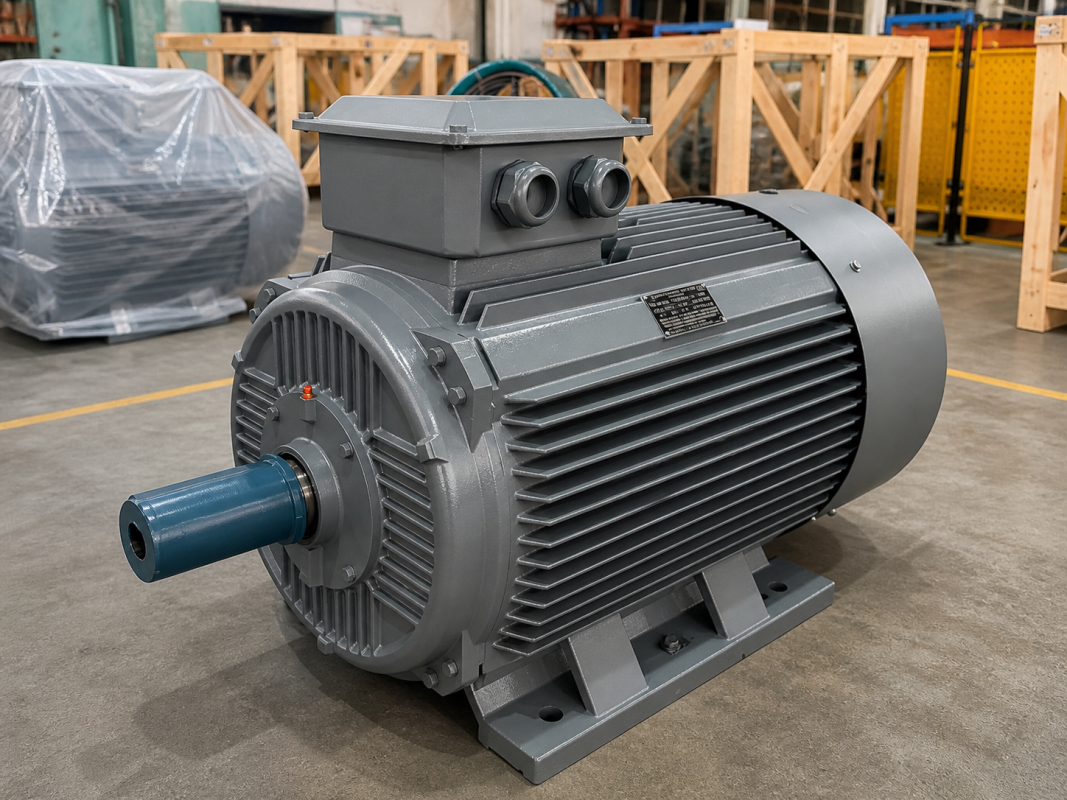

When selecting an electric motor, the first value most people look at is the power rating in kilowatts. Yet the concept that truly determines how a motor will behave in real life, how often it starts and stops, and how long it stays under load is the duty type, also called the duty class. The international standard IEC 60034-1 defines nine duty types, from S1 to S9, to describe the thermal behaviour of motors. These classes mathematically express whether a motor runs continuously or intermittently, how starts and braking contribute to the thermal load, and how varying load profiles affect the windings.
Choosing the wrong duty type can cause a motor that looks correct on paper to overheat and fail in the field. Selecting a motor sized for short-time duty to drive a continuously running conveyor, or conversely choosing a crane motor that starts dozens of times per minute according to S1, leads to both energy waste and premature winding failures. In this article we explain each of the S1-S9 duty types with examples and discuss why the duty cycle is critical in motor selection, from the DRG Motor engineering perspective.
What Is a Duty Type and Why Does It Exist?
A running electric motor generates heat in its windings and iron core because of losses. Part of this heat is dissipated through ventilation, and part is stored in the mass of the motor. The insulation class of the motor (for example 155 °C for class F) defines the maximum permissible winding temperature. The duty type then describes how the motor heats up and cools down over time, and therefore how closely it approaches this temperature limit.
A continuously running motor reaches thermal equilibrium after a certain period: the heat it produces equals the heat it dissipates and the temperature stabilises. An intermittently running motor, on the other hand, may never reach this equilibrium: it heats up while running and cools down while stopped. For this reason the same physical motor can deliver more power in intermittent duty than in continuous duty, because it has the chance to cool between operations. The duty type is the way to express this difference in a standardised language.
The IEC 60034-1 Standard and the Basis of Duty Types
IEC 60034-1 is the fundamental standard governing the ratings and performance of rotating electrical machines. It defines the duty type that must be stated on the motor nameplate and the rated power associated with it. If no duty type is specified on the nameplate, the motor is assumed by default to be rated for S1 (continuous duty). This is an important assumption, because in a duty other than S1 the same motor can usually deliver more power.
The standard also specifies the parameters that must be defined for each duty type. For intermittent duties, the cyclic duration factor (CDF) is given as a percentage; this is the ratio of the loaded time within a cycle to the total cycle time. Expressions such as S3 25% or S3 40% refer to this ratio. For correct motor selection, not only the power value but also the duty type and cyclic duration factor must be evaluated together.
S1-S9 Duty Types Table
The table below summarises the nine duty types defined by IEC 60034-1, their brief descriptions and typical application examples. This table can be used as a reference to quickly see which class suits which application in motor selection.
| Class | Definition | Thermal Behaviour | Typical Application |
|---|---|---|---|
| S1 | Continuous duty | Reaches thermal equilibrium, steady temperature | Pumps, fans, continuous conveyors |
| S2 | Short-time duty | Stops before equilibrium, cools completely | Gate/sluice motors, valve actuators |
| S3 | Intermittent periodic (starting thermally negligible) | Run-stop cycles, starting ignored | Light cranes, cyclic presses |
| S4 | Intermittent periodic with starting | Starting thermal load is accounted for | Frequently starting cranes, lifts |
| S5 | Intermittent periodic with braking | Starting + electrical braking heat | Bridge cranes, fast positioning |
| S6 | Continuous periodic (loaded-unloaded) | Never stops, alternates load and no-load | Rolling mills, some machine tools |
| S7 | Continuous periodic with braking | No stops, starting + braking cycles | High-speed positioning axes |
| S8 | Continuous periodic with variable load and speed | Includes pole/speed changes | Multi-speed drives, winding machines |
| S9 | Non-periodic load and speed variation | Irregular, unpredictable profile | Rolling-mill drives, rail vehicles |
S1 - Continuous Duty
S1 is the most common and simplest duty type. The motor runs under constant load long enough to reach thermal equilibrium. A water pump, a cooling fan or a belt conveyor running 24 hours a day are typical S1 applications. Motors with no duty type on their nameplate are assumed to be S1. In continuous applications such as water pump motor selection, determining the correct rated power is the essence of S1 sizing.
S2 - Short-Time Duty
In S2 duty the motor runs for a short period without reaching thermal equilibrium and then stops long enough to cool down completely. A time is usually stated on the nameplate, such as S2 30 min or S2 60 min. A motor that opens a dam sluice gate or positions a valve is a good example: the motor runs for a few minutes, then waits for hours. In S2 duty a motor of the same size can deliver noticeably more power than in S1, because the long cooling periods prevent thermal accumulation.
S3 - Intermittent Periodic Duty
S3 is an intermittent duty consisting of equal cycles; each cycle contains a running period and a rest period. In this duty the thermal effect of the starting current is considered negligible. The cyclic duration factor percentage (e.g. S3 40%) shows the share of the loaded period within the cycle. A cyclically operating press or a light-duty crane are typical S3 examples. Conveyor belt motor selection requires an S3 evaluation in some stop-start applications.
S4 - Intermittent Periodic Duty with Starting
S4 is similar to S3, but the thermal effect of starting can no longer be neglected. The motor starts frequently and each start produces a significant heat pulse due to the high inrush current. In this duty not only the cyclic duration factor but also the number of starts per hour is a critical parameter. A bridge crane that continuously picks up and releases loads, or a frequently stopping lift motor, falls within S4. Crane and lifting motors are mostly sized according to S4 or S5 duty.
S5 - Intermittent Periodic Duty with Braking
S5 adds electrical braking on top of S4. The motor not only starts but is also electrically braked to stop the load quickly. Both starting and braking produce additional heat in the windings. Bridge and gantry cranes that must position loads precisely, and drives that require rapid stop-start, are good examples of S5. In this duty the thermal calculation of the motor must cover the entire start-run-brake-stop cycle.
S6 - Continuous Periodic Duty
In S6 duty the motor never stops, but the load varies periodically: it runs at full load for a while and at no load (idling) for a while. The thermal behaviour never reaches full cooling, because the motor keeps rotating even when unloaded. The cyclic duration factor is again given as a percentage (e.g. S6 60%). Rolling mills and some machine tools that rotate continuously but have a changing load profile fall into this class. In mill and grinding motor applications, S6 is a frequently encountered duty type.
S7 - Continuous Periodic Duty with Braking
S7 adds braking to S6; the motor runs without stopping but each cycle includes starting and braking phases. There is no idling period; the cycle consists of starting, constant load and braking. High-speed positioning axes and drives that continuously move back and forth are examples of S7 duty. In this duty the braking frequency is the main factor that determines the thermal limit of the motor.
S8 - Continuous Periodic Duty with Variable Load and Speed
S8 duty covers situations where both the load and the speed change periodically. It is typically seen in pole-changing motors: the motor runs at a certain load at one speed and a different load at another speed. A separate cyclic duration factor is defined for each speed and load combination. The relationship between pole count and speed is critical background knowledge for understanding S8 duty, because the speed change is directly related to the pole structure.
S9 - Non-Periodic Load and Speed Variation
S9 is the most complex duty type. The load and speed change in a non-periodic, unpredictable way; there is no repetition that could be defined as a cycle. Frequent overloads are also part of this duty. Rolling-mill drives, rail vehicle motors and heavy-industry drives with variable process loads fall under S9. The challenges of electric motors in heavy industry are mostly related to complex duty profiles such as S9.
The Relationship Between Cyclic Duration Factor (CDF) and Rated Power
To correctly understand the rated power in intermittent duties, it is essential to know the cyclic duration factor. For example, a motor labelled S3 25% stays loaded for only a quarter of a cycle. This motor can be rated at a higher power value than an S1 motor of the same physical size, because the rest periods allow thermal recovery. Comparing two motors by looking only at the kilowatt value is therefore misleading; the duty type and cyclic duration factor must always be read together.
In practice, one of the most common mistakes in the field is running a motor labelled S3 or S4 continuously in S1 duty. In this case the motor is exposed to far more thermal load than it was designed for, and the winding insulation deteriorates rapidly. Conversely, choosing an oversized motor for continuous duty leads to efficiency loss at low load factor and unnecessary investment cost.
Selecting Duty Type with Crane and Conveyor Examples
Consider a bridge crane: the hoisting motor lifts, carries and lowers the load hundreds of times a day. Each movement involves a start, a transport and usually a braking phase. This profile almost always corresponds to S4 or S5 duty. For this motor it is not enough to calculate only the power of the load to be lifted; the number of starts per hour and the braking frequency must also be included in the sizing.
By contrast, a main conveyor that carries material at constant speed for 20 hours a day in a mine is a classic S1 application. Here the motor reaches thermal equilibrium and runs at a steady temperature. In heavy continuous applications such as stone crushing plant motors, S1 sizing is essential, but intermittent duties may also come into play for feeder and screen motors.
The Effect of Frequency Inverters and Variable Speed Drives
In modern plants many motors are driven by frequency inverters. Variable speed drives can reduce the thermal load by limiting the starting current and gradually increasing the speed. This extends motor life, especially in frequently starting S4 and S5 applications. However, in inverter-driven motors the weakening of ventilation at low speed can create a separate thermal problem; in this case an external fan (forced ventilation) may be required. The topic of energy saving with frequency inverters should be evaluated together with duty type selection.
The Difference Between Duty Type and Service Factor
Duty type is often confused with service factor, yet the two are different concepts. The duty type defines the load profile of the motor over time, while the service factor indicates how much short-term overload the motor can withstand. Together they determine the durability of the motor under real operating conditions. When the topic of electric motor service factor is read together with the duty type, motor selection rests on much more solid foundations.
The Effect of Correct Duty Type Selection on Efficiency and Lifespan
Correct duty class selection not only prevents failures but also improves energy efficiency. A motor sized to match the duty profile is often smaller, lighter and more efficient. An oversized motor runs at a low power factor with a low load factor and draws unnecessary reactive power from the grid. When choosing high-efficiency electric motors, correctly defining the duty type determines the real field value of the IE efficiency class.
What Should You Watch for When Reading a Motor Nameplate?
On a motor nameplate the duty type is usually stated next to the power value: for example "11 kW S3 40%". If the nameplate only shows power and speed, the motor is assumed to be designed for S1. If you are going to use this motor in an intermittent application, you must select it according to the real thermal capacity appropriate to the duty type, not according to the manufacturer's continuous-duty power. In three-phase motor selection in industry, the ability to read the nameplate is the foundation of the right decision.
If the Duty Type Is Chosen Wrong, What Happens?
Choosing the wrong duty type is a subtle problem that often appears with delay in the field. When a motor sized for intermittent duty is run continuously, the first weeks may pass without trouble; however, the accumulated thermal load gradually wears out the insulation and results in a winding failure within months. Such failures are usually triggered in summer, when the ambient temperature rises, and cause unexpected production stoppages.
Conversely, when an oversized motor is selected for continuous duty, the problem is not a failure but a permanent loss of efficiency. The motor runs far below its rated load, the power factor drops, and unnecessary reactive power is drawn from the grid. This both raises the energy bill and unnecessarily increases the investment cost. Correct duty type selection strikes the balance between these two extremes, protecting both reliability and operating economy.
DRG Motor for Duty-Matched Solutions
The power value in a motor catalogue is only part of the story. Real performance is determined by which duty type the motor operates in, how often it starts and stops, and which load profile it works under. Each duty class from S1 to S9 describes a different reality in the field, and selecting the correct class is the key to both reliability and energy efficiency. Within the industrial electric motors family, determining the solution best suited to your application's duty cycle is an engineering task.
At DRG Motor, we analyse the duty profile of every application, from cranes to conveyors, from mills to power plants, and recommend the right motor. To evaluate the load profile, starting frequency and running time at your facility together and select the most suitable motor on the S1-S9 scale, you can review our DRG Motor products and contact our engineering team. A motor chosen with the correct duty type is the foundation of years of trouble-free and efficient operation. Return to the DRG Motor home page to explore our full range.